

Wesley Chapel Today — The Pioneers
Episode 3, Part 2 (1894–1947)
Article type: Story
From a three-day house-raising in 1894 to the arrival of rural electricity in 1947, the second and third generations of the Smith family helped turn a scattered frontier settlement into a connected community.
WESLEY CHAPEL, FL — A house can be raised in three days if enough neighbors bring their saws, hammers and willingness to help. Building a community takes decades.
In 1894, friends and neighbors gathered in Wesley Chapel to build a wooden home for newlyweds Daniel Henry Smith and Elizabeth Geiger Smith. Using timber cut from the surrounding woods and $15 worth of hardware, they raised the main house and a separate kitchen structure in three days of shared labor.
That house, where Daniel and Elizabeth raised four children, still survives at Cracker Country. Yet the real story of those decades lies in what happened beyond its porch: annual journeys to Tampa, the arrival of local mail service, the quiet endurance of rural life during the Great Depression and the moment electric lights finally became part of everyday life.
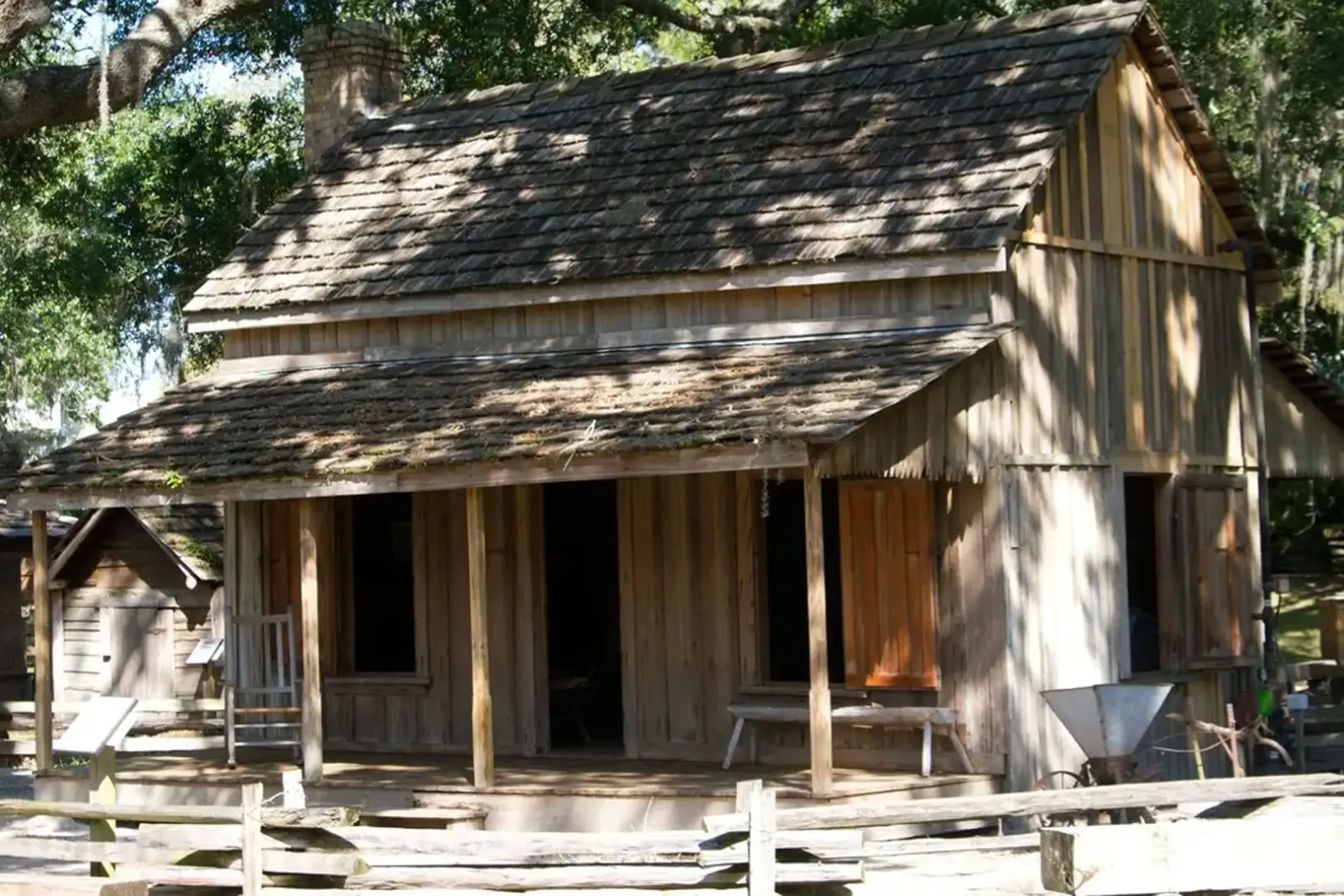
Visit the original Smith House — The 1894 home is preserved at Cracker Country Living History Museum, at the Florida State Fairgrounds. Check the museum’s visitor schedule before traveling.
- Address: 4800 US Highway 301 North, Tampa, FL 33610
- Get directions on Google Maps
- Visitor information
Living Off the Land—and Driving Hogs to Tampa
Life on the Smith homestead followed the rhythm of seasons rather than clocks. Daniel and Elizabeth supported their household through farming, timber, resin work and open-range livestock that roamed freely across the unfenced woods.
Cash was scarce, so families relied on what they could grow, trade or haul to market. Eggs and garden produce were bartered for staples at local stores. Once a year, the Smiths rounded up their hogs and drove them on foot to Tampa to sell—a dusty, demanding trip remembered as taking a full day.
Even with hard physical work filling six days a week, the community stayed closely knit. Neighbors gathered for Fifth Sunday Sings: all-day meetings of hymns, shared meals and conversation that kept scattered families connected across miles of sand trails.
Mail, Elections and Civic Duty at the Turn of the Century
Just as William Riley Smith had helped run the early community school in the 1870s and 1880s, the next generation took on civic duties that held the growing settlement together.
On September 15, 1897, federal postal records mark the opening of a local post office under the name Wesley. The record lists Elisabeth F. Smith as its first postmaster. Whether that entry identifies Elizabeth Geiger Smith, Daniel’s wife, remains a question for the original postal files—but the record still places a Smith at the center of a service that connected the rural settlement to the outside world.
Less than a year later, in May 1898, D. H. Smith served as an election inspector for the district alongside L. M. Strickland and J. J. Gillett. Whether sorting letters or overseeing local ballots, the family’s name continued to appear in the practical work of public life.
Luther Smith and the Coming of Electric Light
As the twentieth century unfolded, Wesley Chapel’s pioneer families began weaving together through marriage as well as work. Luther Daniel Smith married Louneta Stanley, linking two families whose names recur throughout the area’s early history. Son of Daniel Henry Smith and Elizabeth Geiger Smith, Luther became the third generation in the family line followed in this episode and the father of Bill Smith and Ruth Smith Adams.
Luther belonged to the generation that knew kerosene lamps, wood-burning stoves and well buckets. During the Great Depression, those older rural habits remained essential, even as larger cities gained the conveniences of electric grids.

Change began after the federal Rural Electrification Administration launched in 1935. On Aug. 20, 1941, local leaders organized the Withlacoochee River Electric Cooperative to bring power to underserved country roads. World War II delayed materials and construction, but Luther Smith served on the Withlacoochee River Electric Cooperative Board and helped move rural electrification forward in Wesley Chapel.
On April 4, 1947, the cooperative energized its first consumer. For families accustomed to organizing life around daylight and lantern glow, rural electrification signaled a profound change—even if the work of extending lines across the countryside continued community by community.
A New Era at the Doorstep
Daniel and Elizabeth Smith lived long enough to witness much of that transformation—Elizabeth died in 1945, and Daniel in 1955, more than sixty years after neighbors had raised their first roof beams.
By the time the cooperative made its first connection in 1947, a fourth generation was already stepping forward. Young Ruth and Bill Smith had come of age during the Depression and World War II, watching paved roads, automobiles and global events reshape the quiet woods of their childhood.
In the years ahead, it would fall to them not only to live through Wesley Chapel’s modern transformation, but to help make sure the stories of the people who built it were never forgotten.
Next in The Pioneers — Episode 3, Part 3: “The Smiths: Keeping Wesley Chapel’s Memory Alive” follows Ruth Smith Adams and William “Bill” Rollie Smith from the first Pasco County driver’s licenses and World War II to the preservation of the 1894 family home.
Read More in the Series
-
The Pioneers — Episode 1: Introduction to the Pioneers
-
The Pioneers — Episode 2: The Boyettes
-
The Pioneers — Episode 3, Part 1: The Smiths: Where It All Began (1867–1894)
-
The Secret of Wesley Chapel, Part 2: An 1894 Home Holds a Clue to Belonging
-
State Archives of Florida / Florida Memory — FP&L bringing electricity to rural Stuart, circa 1945
| Nº | Sources |
|---|---|
| 1 | Cracker Country historical archives — Smith House · crackercountry.org |
| 2 | Pasco County Board of County Commissioners Resolution CAO16-5156, reproduced by Fivay · fivay.org |
| 3 | Withlacoochee River Electric Cooperative historical records · wrec.net |
| 4 | The Laker/Lutz News — family history recollections · lakerlutznews.com |
| 5 | U.S. Postal Service historical postmaster records · about.usps.com |