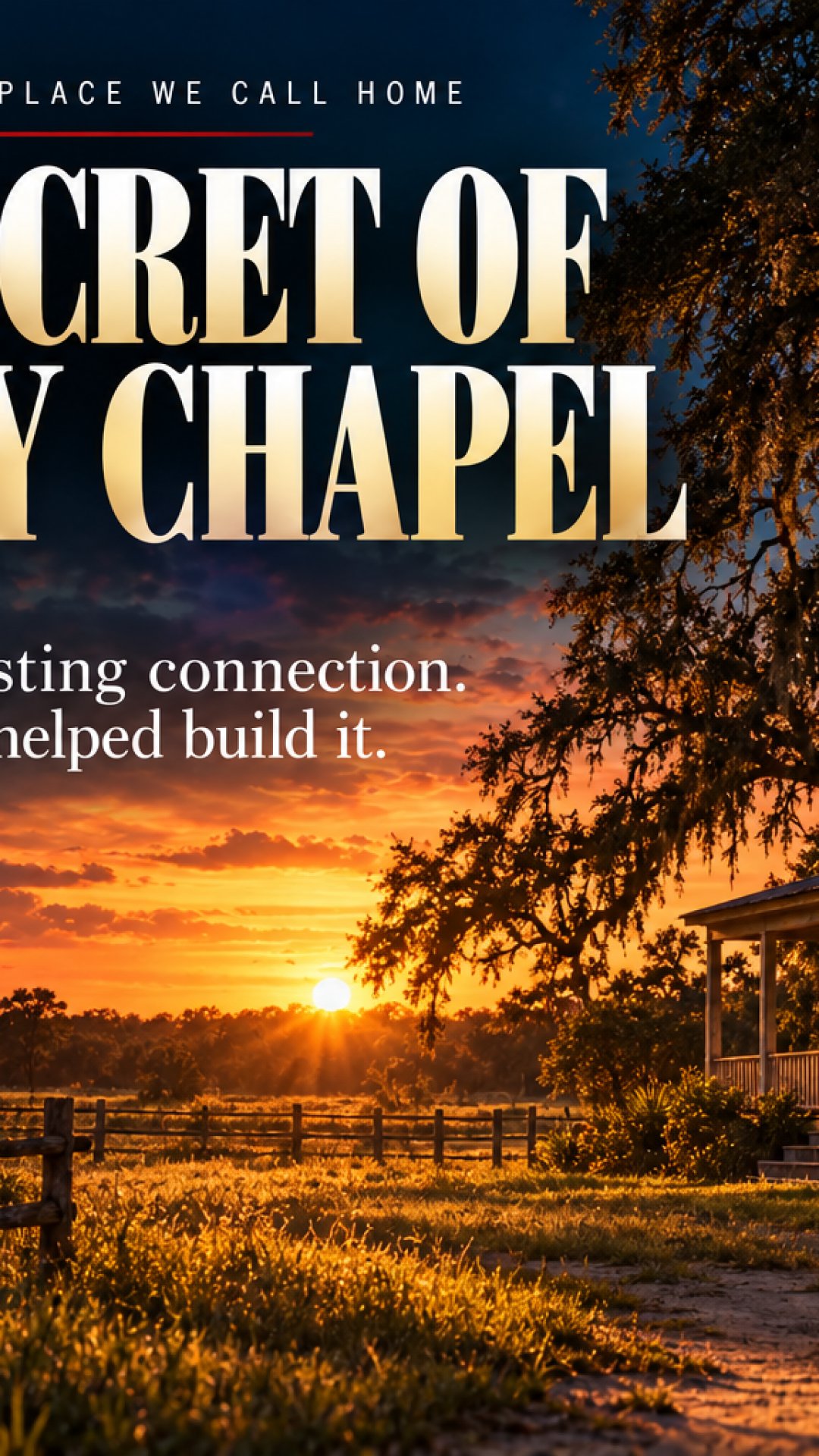


Built by friends and neighbors for a local couple, the Smith House preserves a story of belonging that began long before today's subdivisions.
WESLEY CHAPEL, FL — In the first installment of this series, we asked what makes Wesley Chapel feel like a true home. One clue for continuing that conversation is a house that is no longer here.
The Smith House, preserved at Cracker Country at the Florida State Fairgrounds in Tampa, was built in 1894 for Daniel H. and Elizabeth Geiger Smith. According to the museum, friends and neighbors built it to celebrate the couple's marriage.
It is a small story compared with the size of Wesley Chapel today. But it puts people, and an act between neighbors, at the center of the question that opened our series.
A recorded connection
The museum places the house's origins in eastern Pasco County. Its Wesley Chapel connection also appears in the text of a 2016 county resolution reproduced by the West Pasco Historical Society.
The document honors William “Bill” Smith and Ruth Smith Adams for preserving local history and identifies Daniel as their grandfather. It also records the family's work gathering photographs, documents and memories to help tell the community's story.
That distinction matters. The house's history is presented by the institution preserving it; the family's Wesley Chapel connection is supported by a public record reproduced in the historical collection.
We do not need to make this house the origin of the entire community to recognize its value. It offers a concrete starting point: a preserved building, identifiable people and records that allow further research.
The house moved. Its story continued
According to Cracker Country, the house was donated by the couple's grandson, Willie Smith, and relocated to the museum in 1979.
Its address changed. The story the museum presents remains connected to the family and the help they received from neighbors.
For newcomers to Wesley Chapel, records like these offer another way to know the place. Beyond construction and new developments are lives that can be traced through objects, photographs and preserved buildings.
The house does not explain Wesley Chapel's growth on its own. It helps us ask a question closer to everyday life: which acts and encounters turn an address into a community?
Another name in local memory
An institution in Wesley Chapel also maintains a record of its past. First Baptist Church says it was constituted on June 2, 1878, as Double Branch Missionary Church, with 34 adult members. It adopted the name First Baptist Church of Wesley Chapel in 1999.
That account helps establish the continuity of a congregation across different periods. It does not, by itself, settle every question about the origins of the Wesley Chapel name. That investigation requires comparing additional sources and records.
For this installment, the point is narrower: a house preserved outside the community and an institution still present within it offer different paths toward people and stories that predate today's landscape.
What are we preserving today?
The account of the Smith House's construction invites a question about the present. Help between neighbors may seem ordinary when it happens. Years later, it can become an important memory for a family or neighborhood.
That does not mean earlier life was simple or that everyone shared the same experience. One house and one congregation cannot represent the full diversity of Wesley Chapel's history. They are starting points for widening the investigation, hearing other voices and finding surviving records.
Our question this week is: what act by a neighbor made you feel at home in Wesley Chapel?
Tell us in the comments on Wesley Chapel Today's Instagram. If your family has a photograph, document or memory connected to the community, let us know what it is and the period it relates to. Those leads can guide future installments and will be verified before appearing in reporting.
The Secret of Wesley Chapel is Wesley Chapel Today's Sunday reading series. Each week, we continue looking for the stories that help explain the place we call home.
Sources
Accessed October 4, 2026.
-
Wesley Chapel Today — The Secret of Wesley Chapel, Part 1. The published article was read in full to maintain continuity with the series.
https://wesleychapeltoday.com/news/the-secret-of-wesley-chapel-part-1 -
Florida State Fair Authority / Cracker Country — About Cracker Country, Smith House section. Institutional account from the organization preserving the house, covering the couple, construction year, neighbors’ involvement, donation and relocation.
https://floridastatefairgrounds.com/visit/cracker-country/about/ -
West Pasco Historical Society — Wesley Chapel. Reproduction of Resolution CAO16-5156, dated June 7, 2016, supporting the family’s connection to Wesley Chapel. A separate copy of the original resolution has not yet been obtained; the article’s attribution preserves this distinction.
https://westpascomuseum.org/pascohistory/historicalinformation/communities/wesley_chapel/ -
First Baptist Church of Wesley Chapel — Our Story. Institutional history documenting the congregation’s establishment in 1878 and name change in 1999. The original church minutes were not examined at this stage.
https://www.fbcwesleychapel.org/about-4-1