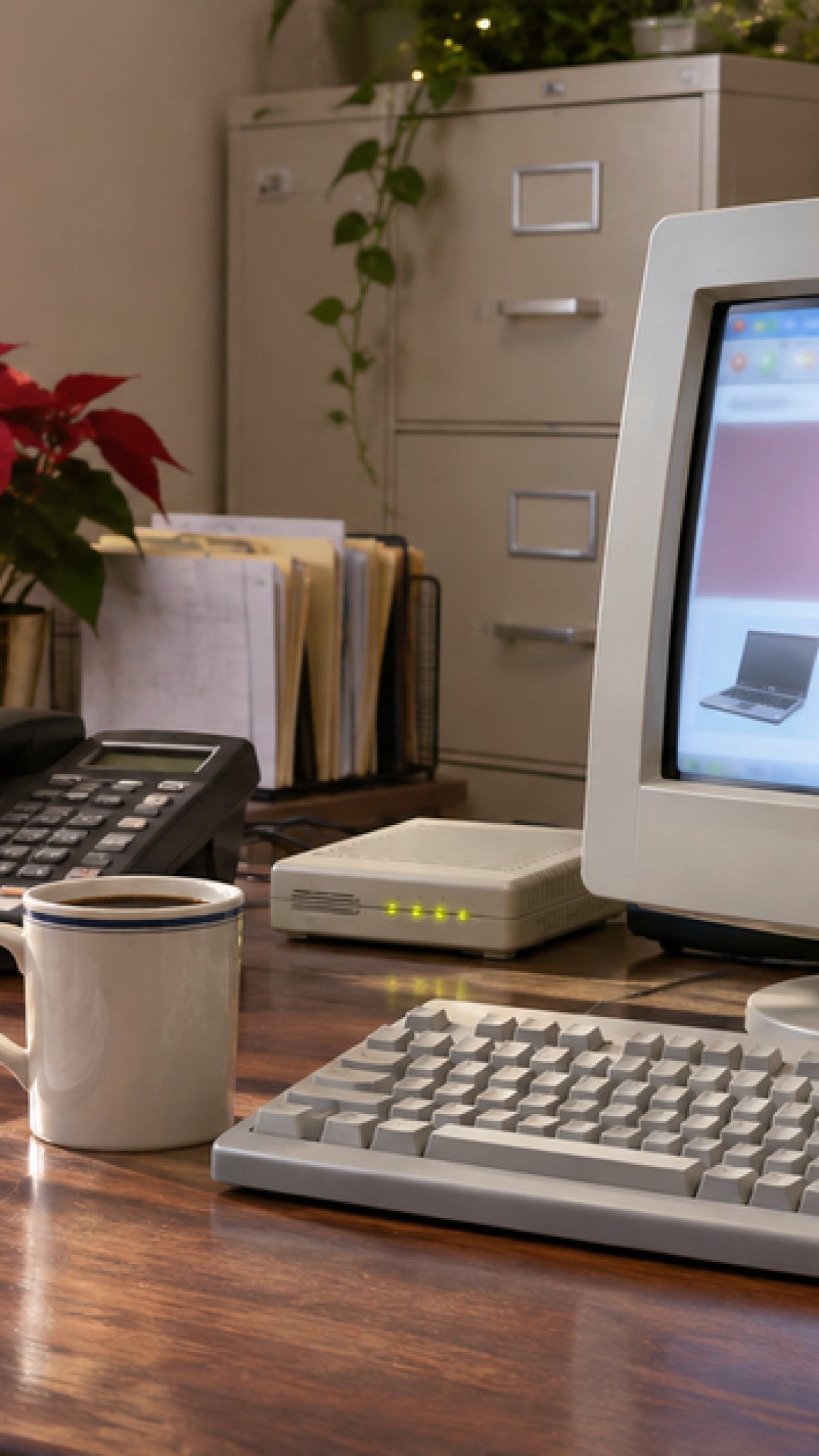


Picture the Monday morning after Thanksgiving in the middle of the 2000s. Millions of Americans returned to their office desks, opened a browser window and resumed a holiday-shopping task they had been considering over the weekend. The familiar story is that they were waiting for faster internet. That was part of it—but not all of it.
In late 2004, broadband was growing quickly without yet being a settled home default. Pew Research Center found that 51% of American adults with home internet connections had broadband in December of that year. For many people, an office connection could still be quicker and more reliable; it also offered a private screen for browsing gifts without family members looking over a shoulder.
Retailers noticed that the Monday after Thanksgiving brought a distinct online surge. The pattern did not begin with a single sale or one suddenly invented shopping rule. It was consumer behavior first: a return to work, an open browser and a holiday purchase that had waited for Monday.
Act I: The connection gap
The early Cyber Monday narrative was never simply that every home had dial-up and every office had broadband. The transition was more uneven. In February 2004, Pew reported that 55% of internet users had broadband access either at home or at work; by the end of the year, broadband had reached just over half of adults with home connections. That gap between growing home access and a more dependable workplace connection helped shape the Monday habit.
There was also a human explanation that survives the technology. A workplace computer gave a shopper a little solitude. Buying a gift from a shared household computer could spoil a surprise; browsing at work let people research and purchase without announcing what was in the cart.
Act II: November 2005, when the pattern got a name
By 2005, Shop.org—the online retail arm of the National Retail Federation—had enough reports from retailers and enough consumer-research evidence to describe the Monday-after-Thanksgiving surge publicly. The group turned that recurring pattern into a name.
The credit belongs to a small team, not a single inventor. In later interviews, former Shop.org Executive Director Scott Silverman identified Ray Greenly, the organization’s vice president of research and member services, and Ellen Davis, who was handling public relations for the NRF and Shop.org, among those involved. Davis later recalled the brainstorming that passed through Black Monday, Blue Monday and Green Monday before landing on Cyber Monday.
Black Monday was discarded because of its association with stock-market crashes. Blue Monday sounded too gloomy; Green Monday did not quite explain the web. “Cyber Monday” did. Davis later said a 2005 web search for the phrase returned essentially nothing—exactly what a new retail label needed: an empty shelf waiting to be stocked.
Shop.org’s Nov. 28, 2005 press release gave the phrase its formal public life. Media coverage followed, retailers embraced the label and a pattern that had been observed in online behavior became a date on the commercial calendar.
Act III: From an American Monday to a global retail language
Cyber Monday began with an American holiday weekend, but its logic traveled easily: create a short, recognizable online-shopping event; coordinate retailers around it; give consumers a reason to visit digital storefronts at the same time.
The event did not spread everywhere in the same way. In Chile, the Santiago Chamber of Commerce says it organized the country’s first cyber event in 2011, when online retail was still developing. In Colombia, the Colombian Chamber of Electronic Commerce says it launched its first Cyberlunes in 2012 to activate online sales and encourage consumer confidence in digital commerce.
Those examples show why Cyber Monday outgrew its original calendar. It did not need American Thanksgiving to work. The phrase had become a useful piece of retail language—one that local chambers, national brands and online merchants could adapt to their own shopping seasons.
Act IV: From $608 million to Cyber Week
Once the name gave retailers a shared banner, the scale rose quickly. Comscore recorded $608 million in U.S. Cyber Monday spending in 2006, the first retail e-commerce day to cross $600 million. In 2010, the total reached $1.028 billion—the first billion-dollar online spending day in U.S. history.
The next transformation was not merely size but shape. Smartphones, faster home connections and retailers’ willingness to begin promotions before Monday stretched the event across the Thanksgiving weekend. Adobe now defines Cyber Week as the five days from Thanksgiving through Cyber Monday.
In 2020, Adobe reported $10.8 billion in U.S. Cyber Monday online spending. Its final 2025 tally reached $14.25 billion. The day that began as a useful label for people shopping from office computers had become the anchor of a global, mobile and multi-day retail ritual.
What started with a modest behavioral pattern did not simply survive the end of dial-up. It adapted. The bottleneck disappeared; the name stayed.
| Nº | Sources |
|---|---|
| 1 | Pew Research Center — New data on internet use and demographics, Dec. 22, 2004 · pewresearch.org |
| 2 | Pew Research Center — Broadband adoption at home grows strongly, Apr. 18, 2004 · pewresearch.org |
| 3 | eMarketer — Q&A with Scott Silverman on the history of Cyber Monday · emarketer.com |
| 4 | Fast Company — How Cyber Monday Was Born · fastcompany.com |
| 5 | Comscore — Cyber Monday 2006 reaches $608 million · comscore.com |
| 6 | Comscore — Cyber Monday 2010 surpasses $1 billion · comscore.com |
| 7 | Adobe — Cyber Monday 2020 reaches $10.8 billion · business.adobe.com |
| 8 | Adobe — Cyber Monday 2025 reaches $14.25 billion · news.adobe.com |
| 9 | Santiago Chamber of Commerce — Chile’s first cyber event in 2011 · ccs.cl |
| 10 | Colombian Chamber of Electronic Commerce — first Cyberlunes in 2012 · ccce.org.co |