

Wesley Chapel Today — The Pioneers
Episode 3, Part 1 (1867–1894)
Article type: Story
When William Riley Smith arrived in post-Civil War Wesley Chapel, there were no street signs, no county lines and no promise of an easy life—only pinewoods, sand trails and the quiet determination of families building a home from scratch.
WESLEY CHAPEL, FL — There are families whose names survive on old deeds and county resolutions. And there are families whose daily stubbornness shapes the ground beneath a whole community.
The Smiths belonged to both.
Long before Pasco County had a courthouse, a paved road or even a name on Florida’s map, small pockets of settlers were already deciding whether this rough, quiet stretch of central Florida could become home. In 1867—just two years after the Civil War ended, when the entire area still belonged to Hernando County—William Riley Smith made that choice.
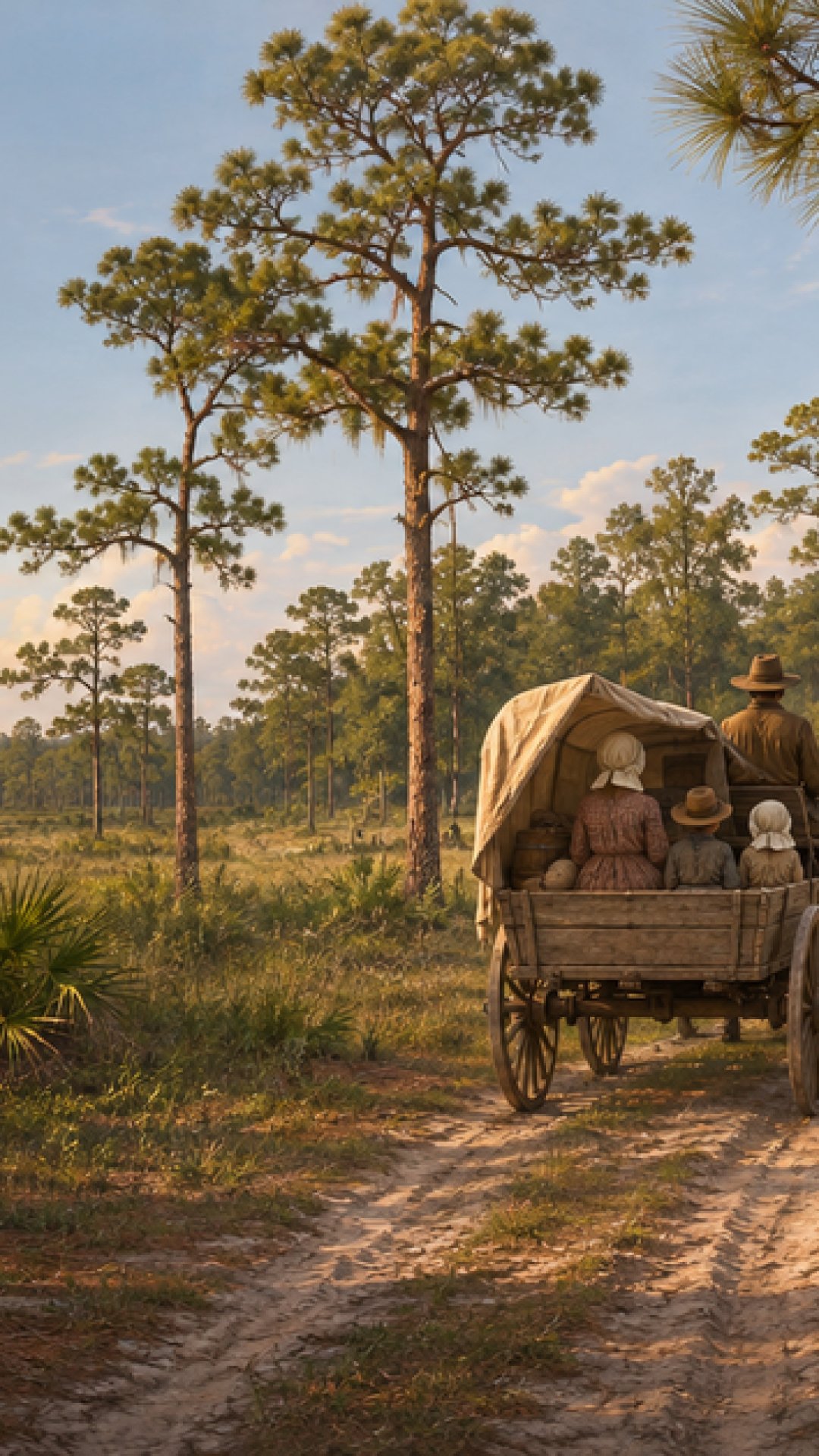
Anyone looking around back then would not have seen the Wesley Chapel known today for State Road 54, busy intersections and growing neighborhoods. They would have seen towering yellow pines, palmetto scrub, standing water in the marshes and deep-sand trails where wagon wheels sank after rain.
In a landscape like that, nothing was handed out. A future was built by hand, season by season, alongside whichever neighbors were willing to share the load.
A Date Worth Looking At More Closely
Pasco County’s 2016 resolution honoring descendants William “Bill” Smith and Ruth Smith Adams places William Riley Smith’s settlement in Wesley Chapel in 1867. At the time, Pasco County did not yet exist; the area was still part of Hernando County.
But a surviving Reconstruction-era voter record adds an intriguing detail to that timeline.
View the original record at Florida Memory
The record shows that a William R. Smith registering in Hernando County’s Precinct 4 reported twelve months of residence in the state, county and precinct by August 1867. If this voter was the same William Riley Smith remembered in Wesley Chapel’s pioneer history, the document raises the possibility that he was already living in the area in 1866.
That distinction matters. The county resolution remains the basis for the established 1867 settlement date, while the voter roll provides an earlier clue—not yet definitive proof—that the Smith presence may have begun sooner. Confirming that the two records refer to the same man will require additional documentary evidence.
Four Generations, One Local Story
The Smith family story told across this episode follows a direct line through four generations rather than attempting to reproduce the family’s complete genealogy. William and Annie Smith raised six children, with Daniel, Lawrence, Ira, Ada and Willie among the names preserved in family accounts.
That line eventually produced another connection important to The Pioneers: Luther Smith married Louneta Stanley, linking the Smiths directly with the Stanley family—another of the pioneer families whose history intersects with early Wesley Chapel.
Seen this way, the Smith story is not an isolated family biography. It is part of a wider network of marriages, neighboring homesteads, schools, farms and community institutions that tied Wesley Chapel’s early families together.
A Promise Written in Soil and Sweat
For the first generation of Smiths, land was never an abstract line on a survey map. It was food on the table, shelter from summer storms and the foundation for a large family.
Like many post-war settlers, William Riley Smith turned to the Homestead Act of 1862—a federal promise that offered up to 160 acres of public land to families willing to live on it, clear it and make it productive for five continuous years. By October 1883, correspondence from Florida’s Commissioner of Lands and Immigration recorded Smith’s formal claim on local ground.
The bargain demanded everything a pioneer household had. Days started before sunrise and revolved around clearing pine stumps, tending crops and managing cattle and hogs that roamed the open range. Centuries later, descendants like William “Bill” Smith and Ruth Smith Adams—honored by Pasco County in 2016 for their family’s deep local roots—would still remember stories of a world shaped by farming, open-range livestock and self-reliance.
Neighbors Who Built a School Together
Clearing land kept a family alive, but it took something else to turn scattered homesteads into a real settlement. It took people willing to show up for one another’s children.
In the late 1870s and early 1880s—years before Pasco County was carved out of Hernando County—local school rolls captured a quiet portrait of how the community worked. Alongside names like D. Godwin, Thomas Boyd, J. A. Boyett and J. J. Gillett stood W. R. Smith, helping keep the neighborhood school running.
In an era when every trip took hours by wagon and every repair required planning, running a rural school meant taking responsibility for the next generation’s future. The Smiths, Godwins, Boyetts and Gilletts were not just neighbors sharing sandy borders; they were building the first shared institutions of Wesley Chapel side by side.
Passing the Torch to a New Generation
William and Annie Smith raised a large household in those pinewoods, including their son, Daniel Henry Smith. By the early 1890s, Daniel was ready to start a chapter of his own on the same familiar ground—planting crops, tending citrus groves and raising cattle along what would one day become the State Road 54 corridor.
Then came 1894.
That year, friends and neighbors gathered across the clearing to raise a wooden home for Daniel and his bride, Elizabeth Geiger Smith. Nobody called in a contractor or waited for a ribbon-cutting ceremony. They brought timber, tools and muscle, lifting beams together the way frontier communities always did when a young couple started out.
More than a century later, that very house still stands—preserved today at Cracker Country as a tangible piece of Wesley Chapel’s earliest days.
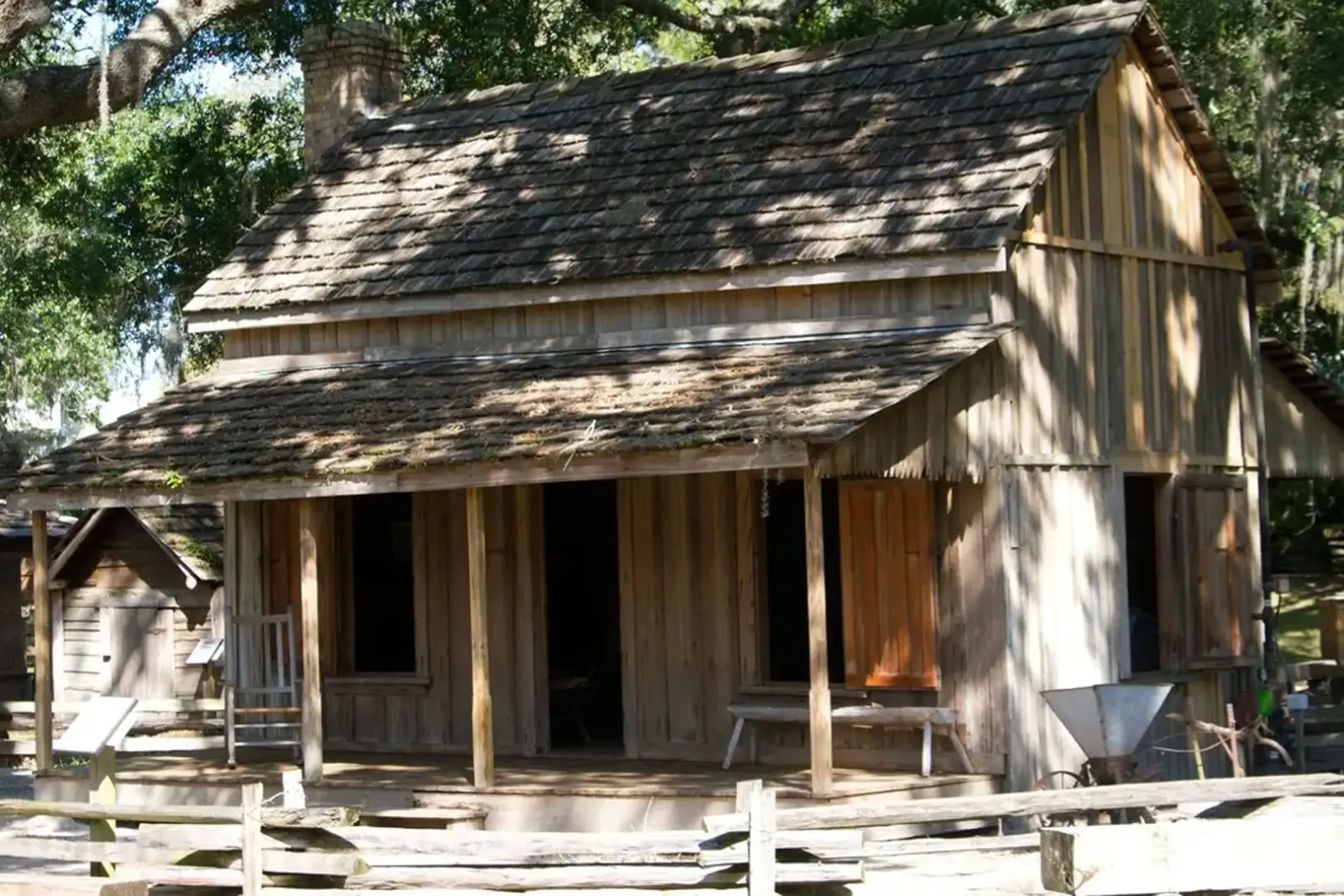
Visit the original Smith House — The 1894 home is preserved at Cracker Country Living History Museum, at the Florida State Fairgrounds. Check the museum’s visitor schedule before traveling.
How to get there
- Destination: Cracker Country Living History Museum, Florida State Fairgrounds
- Address: 4800 US Highway 301 North, Tampa, FL 33610
- Open directions in Google Maps
- Check Cracker Country visitor information
Before there were traffic lights, shopping centers or master-planned communities, there were families like the Smiths—people who arrived in an unmarked landscape, put down roots and stayed long enough to turn a stretch of woods into home.
The Pioneers is Wesley Chapel Today’s historical storytelling series exploring the families, homesteads and early institutions that shaped the community.
Related Reading
- The Secret of Wesley Chapel, Part 2: An 1894 Home Holds a Clue to Belonging
- The Secret of Wesley Chapel, Part 5: The Woman Who Drew the Ground Beneath Godwin
| Nº | Sources |
|---|---|
| 1 | Pasco County Resolution honoring Bill Smith and Ruth Smith Adams, reproduced by Fivay · fivay.org |
| 2 | State Archives of Florida / Florida Memory — William R. Smith voter registration, Aug. 23, 1867 · floridamemory.com |
| 3 | U.S. National Archives — Homestead Act of 1862 · archives.gov |
| 4 | FDOT Cultural Resource Assessment Survey — State Road 54 · fdotd7studies.com |
| 5 | Cracker Country historical archive — Smith House · crackercountry.org |
| 6 | The Laker/Lutz News — family history recollections · lakerlutznews.com |