

A Sunday story from Wesley Chapel Today
The Secret of Wesley Chapel, Part 5: The Woman Who Drew the Ground Beneath Godwin
There are people whose names survive on signs, maps and old papers. Then there are people whose decisions survive in the shape of a whole community.
Mary Jane Godwin belonged to the second kind.
In the earlier chapters of The Secret of Wesley Chapel, we followed the names that once competed, quietly and stubbornly, for a place on the map: Double Branch, Gatorville, Godwin and Wesley Chapel. We met the creeks, sandy roads, churches and small institutions that helped a scattered rural settlement begin to feel like home.
But every map has a person behind it. For Godwin, that person was Mary Jane.
Mary Jane was not the sort of woman to wait for civilization to arrive with a polished sign, a paved road and a grand opening ceremony. Out here, under tall pines and among palmettos, you built what you needed. You planted what you could. You looked after your family. And if the community needed a place to gather, to pray or to say goodbye, someone had to make room for it.
Mary Jane made room.
Her husband, Jacob, was connected to the daily business of a growing settlement. He handled mail. He understood the small practical problems that could delay a schoolhouse: a missing hinge, a lock that had to be bought, a door that would not stay shut. In a place where every journey took time and every repair required planning, those details mattered.
But Mary Jane could see beyond the daily repairs.
She looked across the land around Godwin and imagined more than trees, cattle trails and family homesteads. She imagined neighbors becoming a community. She imagined people having a place to meet on Sunday, to sing together after a long week and to carry one another through difficult seasons.
And she imagined something else, too: a place to remember.
In January 1890, Mary Jane set aside two acres of land. Two small pieces of ground, perhaps, when measured against the open Florida landscape. But a great deal when measured against a family’s future.
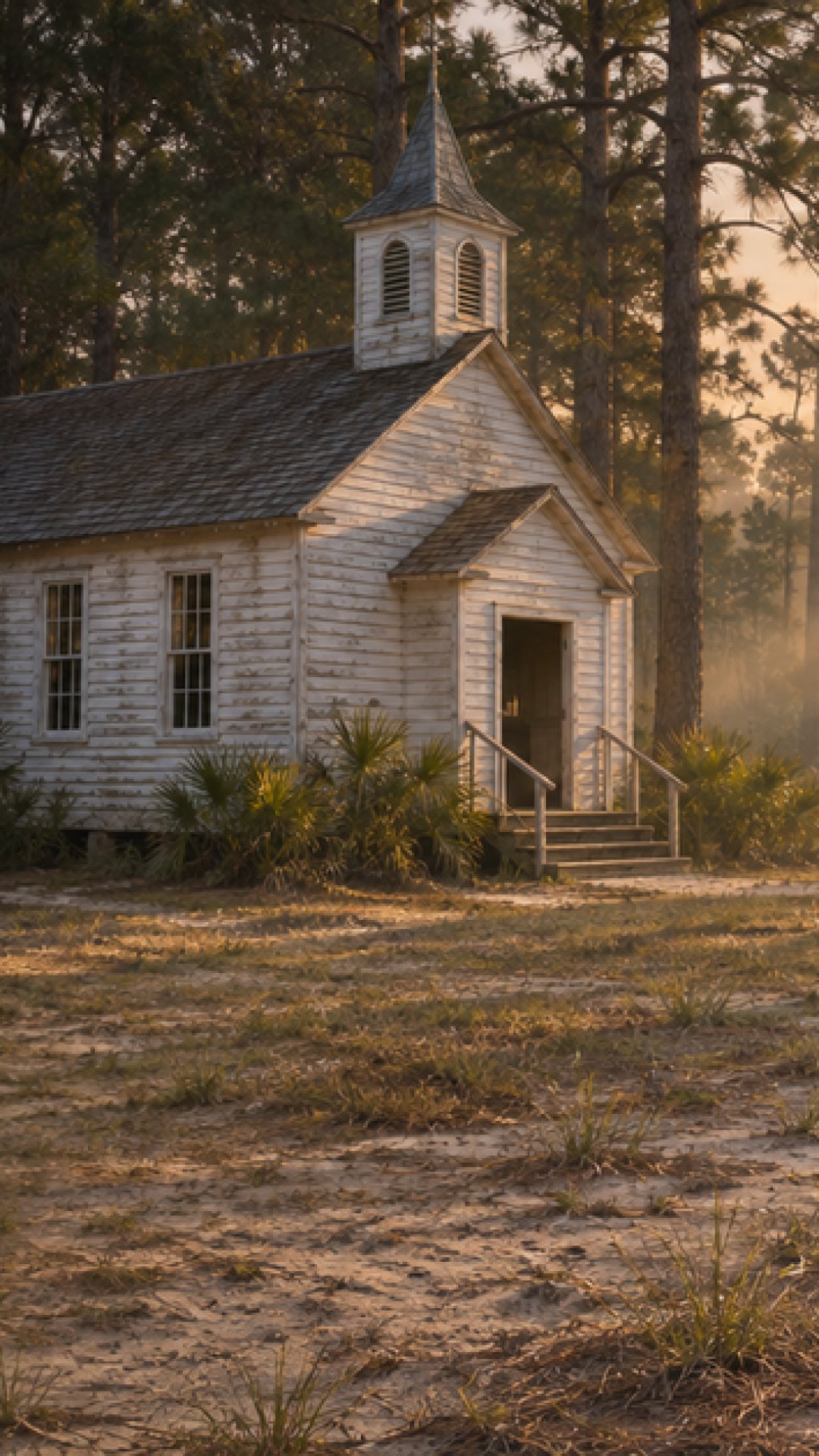
One acre was for the church. The other was for the cemetery.
It was a simple decision with a permanent echo.
The church gave people a place to gather while they were alive. The cemetery gave them a place to remain near one another after they were gone. Between the two stood the whole rhythm of a community: weddings, hymns, children, prayer, work, grief, hope and ordinary Sundays that slowly become the memory of a town.
That is how Godwin began to feel less like a family name and more like a place.
Not because someone declared it with a speech. Not because a developer placed it on a brochure. And certainly not because a committee spent three months debating the right font for a welcome sign.
It happened because people such as Mary Jane understood that land could become more than property.
It could become belonging.
The old community was not easy. The air was heavy. The roads were rough. Work was physical, and life could turn hard without much warning. Families lived close to the land, close to the weather and close to the limits of what they could build with their own hands.
But Mary Jane’s gift changed the meaning of that ground.
A church became a promise that people did not have to face every burden alone. A cemetery became a promise that no one would be forgotten far from home. Together, they gave the scattered families of the area something modern Wesley Chapel still understands: a community is not only made of houses.
It is made of the places where people show up for one another.
Mary Jane eventually came to rest beside the church land she had chosen to give away. It is a quiet ending for a woman whose decision was anything but small.
More than a century later, Wesley Chapel is louder, faster and much harder to cross during rush hour. Its roads are wider. Its neighborhoods have names that sound like they came from a marketing meeting. Its traffic lights have become part of the local personality.
But beneath all of that is an older idea.
Before there was a growing town, there was a woman who looked at a piece of land and decided it should hold more than her own future.
She gave one acre to the living. She gave one acre to memory.
And, without knowing it, she helped draw the ground beneath Godwin.
The Secret of Wesley Chapel is a work of fiction and Wesley Chapel Today’s Sunday story series. New episodes arrive every Sunday. The separate documentary series, based on researched records and verified sources, publishes new chapters on Wednesdays.