

WESLEY CHAPEL, FL — Sunday, October 18, 2026
Imagine waking up in Wesley Chapel more than a century ago. No bustling malls, endless stoplights or groceries delivered to your doorstep. Instead, there were farms, pine forests, creeks, dirt roads and families who counted on the land—and on one another.
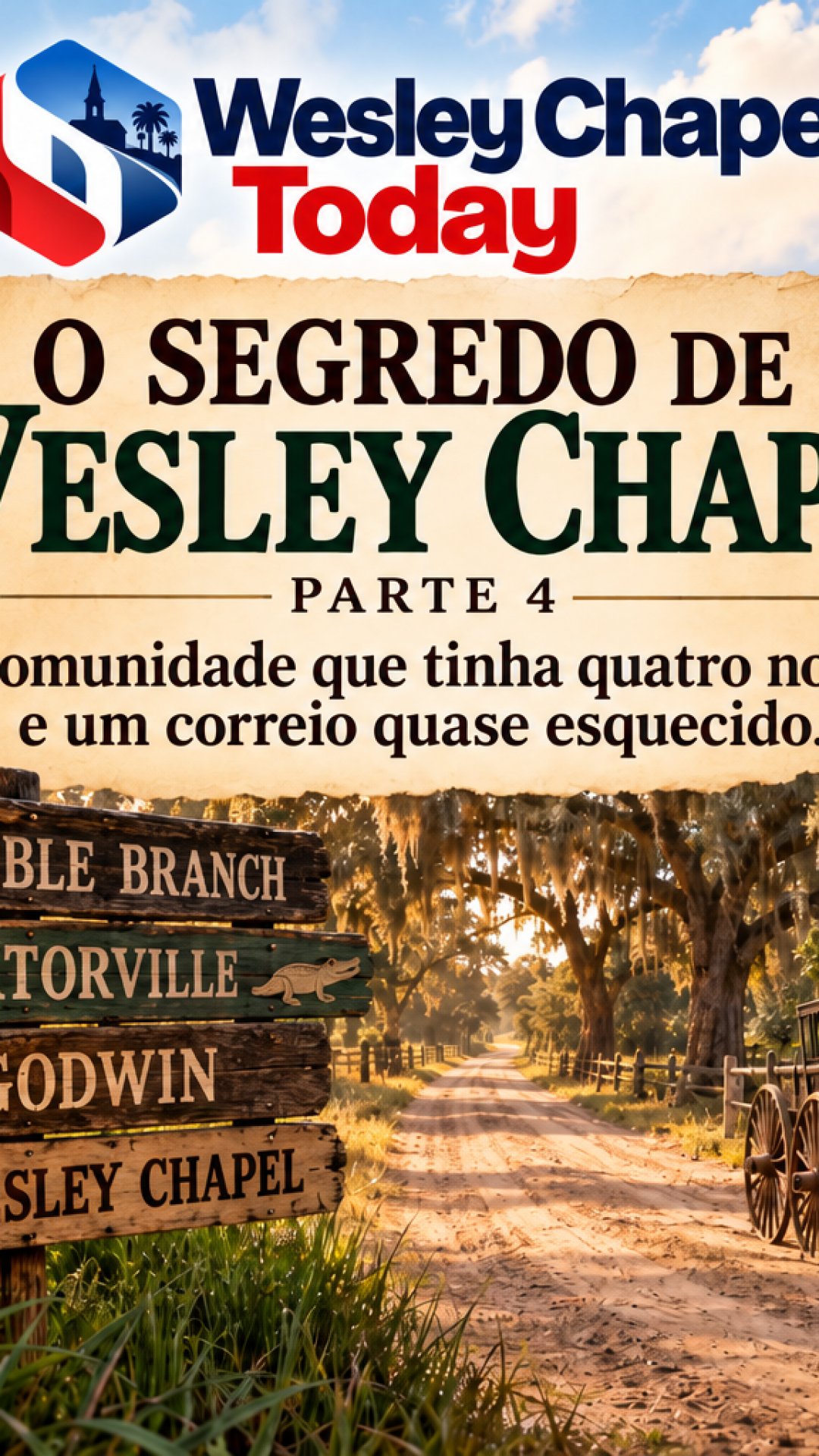
The place even had more than one name. Double Branch? Gatorville? Godwin? Wesley Chapel? All four names are part of the history of the very same community.

Florida road, circa 1914. Period illustration; not a photograph of Wesley Chapel. Source: Wikimedia Commons, public domain.
A Community With Four Names
On June 30, 1922, the Dade City Banner published a story by C. B. Taylor about a farming community roughly eight miles west of Zephyrhills and eight miles south of San Antonio. The reporter named four ways locals knew it: Double Branch, Gatorville, Godwin and Wesley Chapel. He identified Wesley Chapel as the official name.
Picture a traveler asking for Double Branch and being directed toward Gatorville, only to hear Godwin farther down the road. That's an imagined exchange, not a historical quotation, but the confusion would be understandable. Each name tells us something about life in Old Florida.
Double Branch: A Name From the Water
Two streams crossing Boyette family land gave Double Branch its name. In the 1800s, natural features made perfectly good landmarks; there was no need for a committee to approve a memorable neighborhood brand.
Double Branch also became part of the area's religious history. A Baptist congregation organized in 1878, later becoming the First Baptist Church of Wesley Chapel. In a countryside of scattered homes, churches were gathering places where families worshipped and built community.

Historic church architecture in Florida; not the Double Branch church. Photo: Stephen B. Calvert, Wikimedia Commons, CC BY-SA 3.0.
Gatorville: A Very Florida Nickname
The name Gatorville suggests the alligators and waterways familiar to generations of Floridians. It survives in the historical record as a local nickname, not a separate incorporated town. The natural world wasn't merely scenery to the earliest residents; it was part of everyday life.
Godwin: A Pioneer Family and a Post Office
Godwin was associated with one of the area's pioneer families. The historical record also describes a Godwin post office established on March 15, 1888, with Jacob Godwin as its first postmaster.
In a community without smartphones or instant messaging, the post office mattered enormously. Letters carried family news, commercial orders and documents across distances that were difficult to travel. Having a nearby postal service helped scattered homesteads stay connected.

Rural U.S. post office, 1938, location unknown. This is not the Godwin or Wesley post office. Smithsonian National Postal Museum / Wikimedia Commons; no known copyright restrictions.
Wesley: The Post Office With the Shorter Name
A separate post office named Wesley opened on September 15, 1897, with Elisabeth F. Smith as the first postmaster. Notice the detail: the postal name was Wesley, without Chapel. The office closed on September 30, 1902, and mail service shifted to Abbott, the settlement later associated with Zephyrhills.
The two post office names help explain why old maps, documents and local recollections can refer to the area differently. Those names overlapped; they should not be mistaken for a tidy sequence of four official town renamings.
Where Did Wesley Chapel Come From?
The lasting name recalls a Methodist chapel formerly located near today's SR 54 and Boyette Road intersection, and ultimately the name of John Wesley, an influential figure in Methodism. In the nineteenth century, a chapel could provide a community's most recognizable landmark.
Over time, Wesley Chapel became the identity people continued to use, even as older nicknames survived in memory.
Good Farmland, Tough Roads
Taylor's 1922 newspaper report praised the soil and agricultural potential but also noted a familiar obstacle: transportation. Poor roads made it harder for farmers to bring produce to market.
A century later, transportation is still part of Wesley Chapel's everyday conversation, although today's vehicles and destinations would astonish the early settlers. The community gradually evolved from a landscape of rural work into a growing residential and commercial area.
A Sunday Thought
History isn't only preserved in monumental buildings or famous speeches. Sometimes it lives in a pair of creeks, the name of a family, a small country church or a post office that lasted just a few years.
The next time you travel near Boyette Road, imagine those old paths and the people who depended on them. Wesley Chapel may have one familiar name today, but it holds the memories of several different places.
Our Sunday history series continues next week.
Sources
- West Pasco Historical Society, Wesley Chapel: https://westpascomuseum.org/pascohistory/historicalinformation/communities/wesley_chapel/
- History of Pasco County, Wesley Chapel: https://www.fivay.org/wesley_chapel.html
- Historic road photo, Wikimedia Commons: https://commons.wikimedia.org/wiki/File:AndersonHighwayFlorida.jpg
- Historic church photo, Stephen B. Calvert, CC BY-SA 3.0: https://commons.wikimedia.org/wiki/File:First_Congregational_Church_UCC_Palm_City_FL_016.JPG
- Smithsonian National Postal Museum rural post office photo: https://commons.wikimedia.org/wiki/File:Customers_in_a_Rural_Post_Office_%282551076788%29.jpg