
The Name That Refused to Die
Before the asphalt, before the master-planned communities, and long before anyone envisioned shopping malls along State Road 54, this corner of Pasco County was not a town. It was an argument between nature and the stubborn families trying to tame it.
The land already had a voice. The waters of two twin creeks cutting through the Boyette homestead dictated where wagons could cross, earning the territory its first practical identity: Double Branch.
Read more here: Double Branch, the Name Written by Water
Yet step off the high ground into the black mud, and the wild gave it another, coarser title: Gatorville. It was not a town on any surveyor’s deed. It was a warning whispered between settlers who knew that in the pine scrub and standing cypress swamps, men were outnumbered by things with teeth.
Read more here: When the Land of Traffic Was Known as Gatorville
Then came the families wanting order. They wanted mail, commerce and neighbors. For a season, the settlement leaned on the name Godwin, stamped across letters and tied to the bloodlines cutting paths through the woods.
Read more here: Before the Traffic Lights, There Was a Community
Four names fought for the same plot of dirt. But the one that survived did not come from a creek, a reptile or an ambitious pioneer.
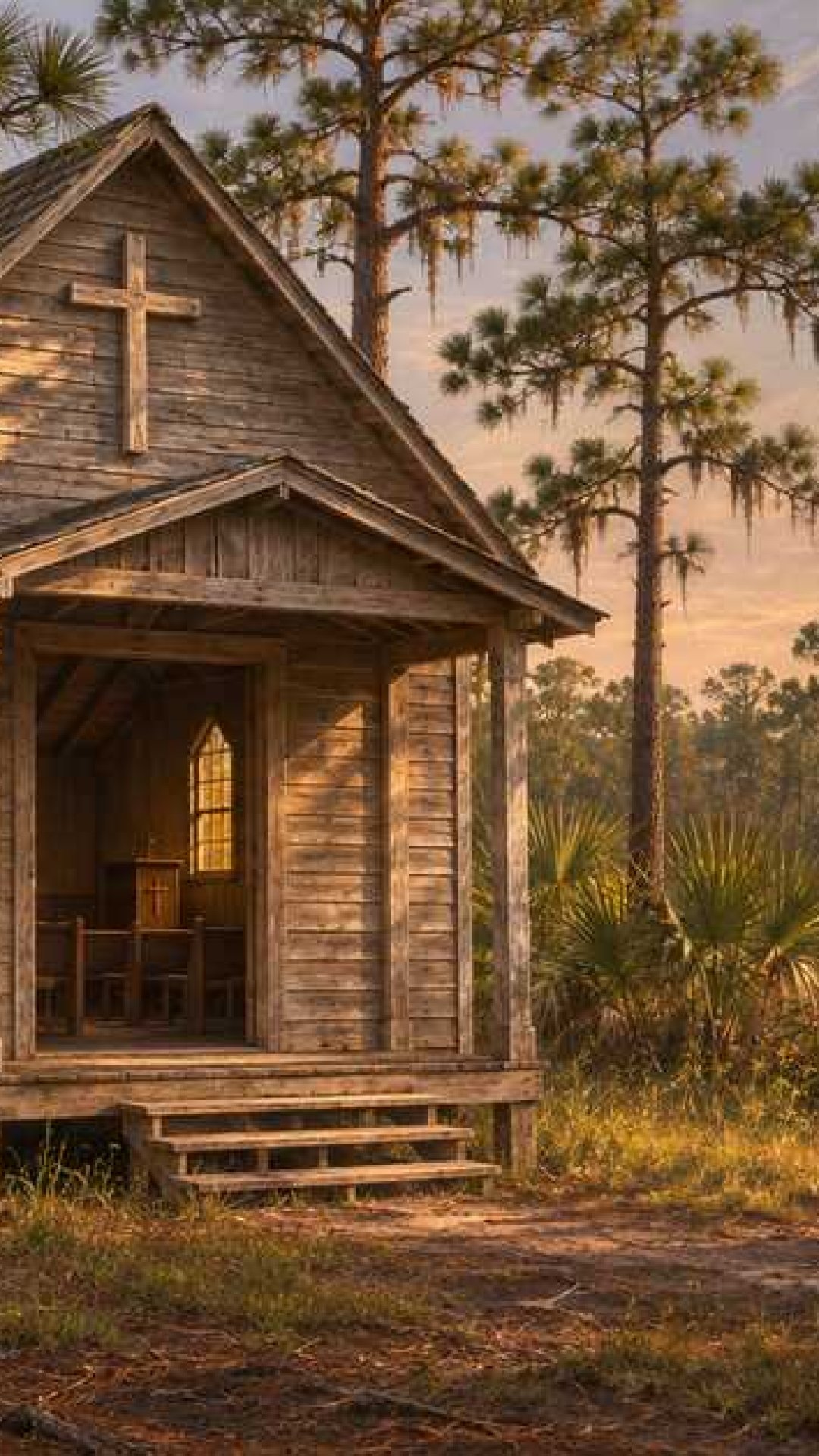
It came from a small, solitary wooden sanctuary built where dust met wheels.
Around 1877, near the northwest corner of what travelers now navigate as State Road 54 and Boyette Road, a modest Methodist chapel rose from the clearing. Its congregation dedicated the house of worship to John Wesley, the English preacher whose name had traveled across oceans and into the American frontier.
John Wesley never set foot in Florida. He never swatted away a mosquito in a Pasco swamp, nor did he look across a canopy of longleaf pine. But out here, where homes were miles apart and the woods turned dark at night, the chapel became the compass.
“Meet me by Wesley’s chapel.”
That was how a building became a direction.
The word chapel mattered because the people who lived there needed more than a name. They needed a place. A roof. A landmark. Somewhere a traveler could be told to turn, stop or wait.
The postal service later tried to compress the name into the one-word “Wesley.” But the longer name refused to disappear. It remained in the language of the community, in school records and in the memory of people who knew the road before it became a highway.
The little chapel eventually vanished from the landscape. Wood gives way to weather. Roofs surrender to rain. Paths become roads, and roads become traffic.
But the name stayed.
Gatorville faded into a story people told with a smile. Double Branch retreated into the memory of water and old clearings. Godwin became a name carried through family stories.
The chapel was gone. But its ghost kept the map.
By the time the wider community needed one name, Wesley Chapel was still there — not as a building, but as a memory strong enough to outlive it.
Today, thousands of cars pass through the intersections and new neighborhoods stretch across former pastures. Almost no one looks toward the old crossroads and imagines a wooden roof in a clearing.
Yet every time we type the address, send a package or tell someone where we live, we repeat the name of a chapel that disappeared long ago.
Some places survive because their buildings remain.
Wesley Chapel survived because its name refused to die.
A note from the editor
This Sunday chapter is a fictional narrative inspired by the names, landscapes and local memories associated with Wesley Chapel. It is part of The Secret of Wesley Chapel, a creative series from Wesley Chapel Today.