

The Secret of Wesley Chapel: When the Land of Traffic Was Known as Gatorville
For those who today spend minutes stopped at the State Road 54 traffic light, listening to the sound of car engines and watching the endless construction of new subdivisions, it is almost impossible to see what lies beneath the asphalt.
A little more than a century ago, there was no air conditioning, asphalt or drywall fencing. The air smelled of wood smoke, pine resin and wet earth after the afternoon storm. People did not arrange meetings by text message: they shouted from one end of the clearing to the other or waited until Sunday to find out who had survived the fever, the snakes or the flood.
Last Sunday, we recovered the story of the Godwins — pioneers who donated land for the first school, built a church and maintained the first local post office. We promised to travel back in time to uncover a nickname that more formal books often hide in a footnote.
That name was Gatorville.
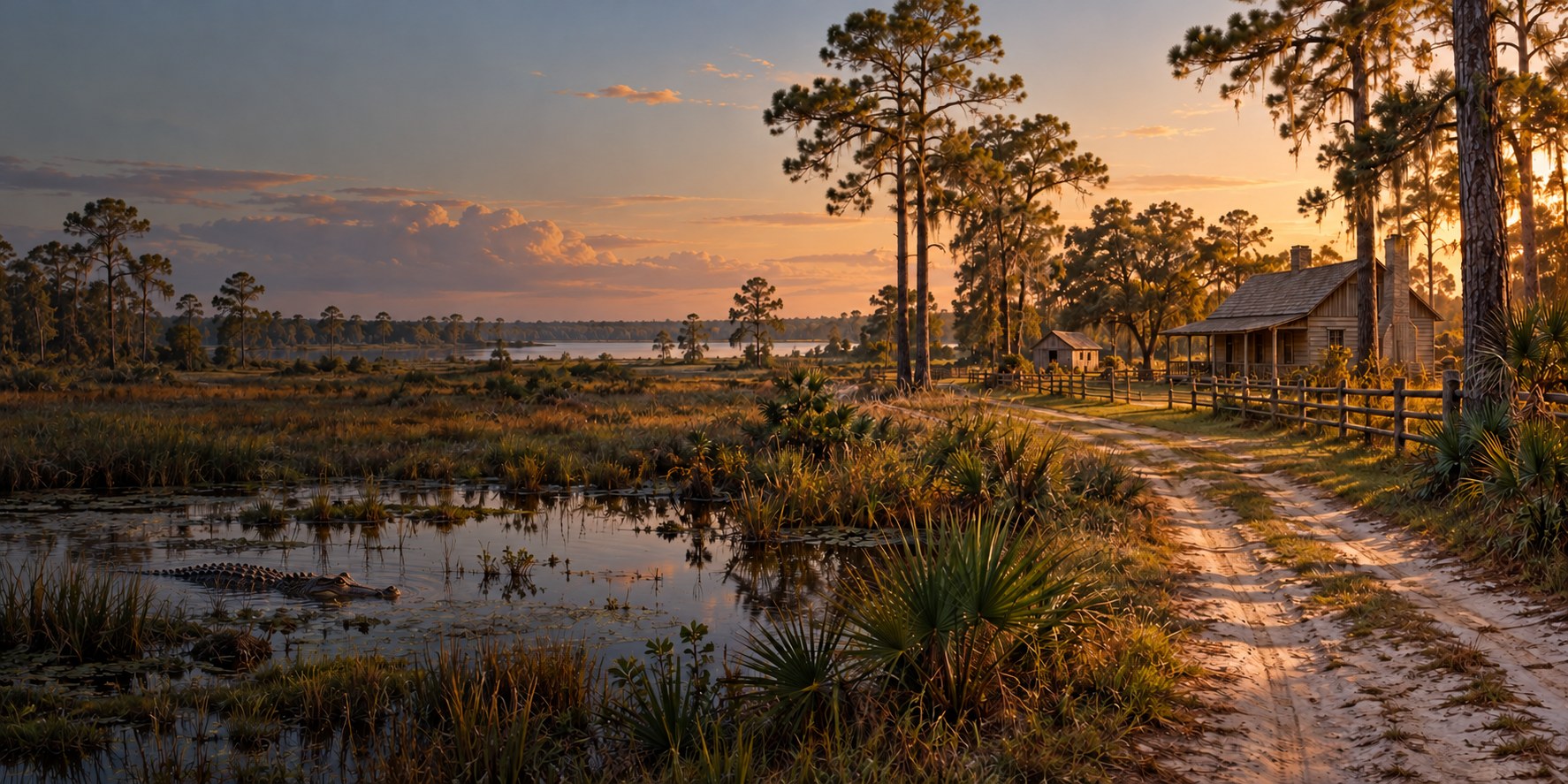
Editorial illustration of the landscape described in the article.
Four names, one sandy crossroads
On June 30, 1922, a reporter named C. B. Taylor traveled through the Florida interior by horseback and wagon to write for the Dade City Banner. What he found southwest of Pasco County was a handful of families scattered across a vast green landscape. In his column, he wrote with surprise:
“About eight miles west of Zephyrhills and the same distance south of San Antonio there is a somewhat scattered but prosperous community known by the several names of Double Branch, Gatorville, Godwin and Wesley Chapel. The latter is the official name.”
That confusion of names summed up the dilemma of the people who lived there:
- Double Branch was born from the water. It was the name that pioneer Thomas Ashley Boyette gave to the church he helped establish in 1878, because two dark-water streams crossed right along the boundary of his land — streams that today run hidden through concrete drainage structures beneath Boyette Road.
- Godwin was born from civic effort. It came from Jacob Godwin, who in 1888 secured federal authorization to open a post office in his home, ensuring that letters could arrive without depending on informal couriers.
- Wesley Chapel was born from faith and respectability. It was the name of the small Methodist chapel built of rough wood near the present-day intersection of SR 54 and Boyette Road, named in honor of theologian John Wesley.
- And Gatorville? Gatorville was born from raw survival.
Visual table of the four names presented in the article.
Real life where the wild thing lived
Those who called the area Gatorville were not making a tourism joke. They were describing the neighborhood’s most numerous neighbor.
Central Florida from the 1880s to the 1920s did not forgive weakness. Families such as the Boyettes, Kerseys, Gilletts and Stanleys lived in simple houses made of unfinished pine boards (pine cracker shacks), raised on wooden posts to keep out ground moisture and make it harder for poisonous animals to get inside.
The day began before sunrise:
- The sharp smell of turpentine: Men spent weeks in camps deep in the forest, making V-shaped cuts in the trunks of yellow pines to bleed the resin. The work was heavy, sticky and dangerous, and the resin was used in paints, varnishes and the caulking of ships.
- Cattle in the woods and free-ranging pigs: Cows and pigs were raised loose under the open-range system. To gather them, people used long rawhide whips whose crack cut through the silence of the woods — the origin of the classic term Florida Cracker.
- The still and the charcoal: When an unusual frost burned the crops or a drought destroyed the corn, people turned to the deep woods for survival. Earthen ovens dug into the ground slowly burned wood into charcoal, while clandestine moonshine stills boiled corn liquor in the shadows of the Cypress Creek waterways, far from the eyes of federal inspectors.
- Alligator hunting: Alligators were not a zoo’s ecological attraction. They were a constant threat to calves and chickens, but they also meant salted meat in the pot during difficult months and rough hides traded for coffee, salt, ammunition and flour at trading posts in Tampa or Brooksville.
Visual table based exclusively on the activities described in the article.
For the drovers and hunters who followed those muddy trails, that place did not have the grandeur of a chapel or the formality of a postal seal. It was simply the village of alligators: Gatorville.
Why did the chapel defeat the alligator?
As the years passed, the sandy trails began to be leveled, and children needed officially recognized schools. When the community needed to choose a name to place on postal and government maps, there was a conscious choice:
Gatorville seemed too rustic, almost wild. Godwin honored only one clan. Double Branch became associated with the Baptist chapel and the rural road.
Wesley Chapel won — a name that sounded respectable, conveyed community order and placed the church at the center of social life.
The great modern leap came much later. For decades, Wesley Chapel remained a quiet refuge of orange groves, pastures and woods. It was the arrival of Interstate 75 and the opening of Saddlebrook Resort in 1979 that opened the doors to accelerated development, transforming pastures and sawmills into one of the busiest suburbs in the state.
The clues the asphalt could not erase
Nowadays, almost no one introduces themselves by saying they live in Gatorville. But if you know where to look, the past is not dead:
It appears again whenever torrential August rains soak the lowlands of the Cypress Creek and Trout Creek basins, causing water to rise exactly where the pioneers’ old ponds once stood.
It appears again when a six-foot alligator calmly decides to stroll across the neatly cut lawn of a gated community near Bruce B. Downs, unconcerned with cars and alarms, as if simply reclaiming the trail its species used a century before concrete existed.
And it appears again in the names of quiet streets and the weathered gravestones at the Boyette Road cemetery, where the men and women who opened this land through fire and hard work now rest.
Kept in a drawer
The history of great events is often engraved on bronze monuments, but the history of a place like Wesley Chapel lives in the drawers of ordinary families.
Do you have an old family photograph, a yellowed letter, a piece of rural work equipment, or have you heard stories from your grandparents about the time when State Road 54 was nothing more than a dirt trail?
Share them with us. Preserving these memories is the only way to ensure that future generations know that beneath this modern forest of asphalt, there was once a free, brave and untamed place called Gatorville.