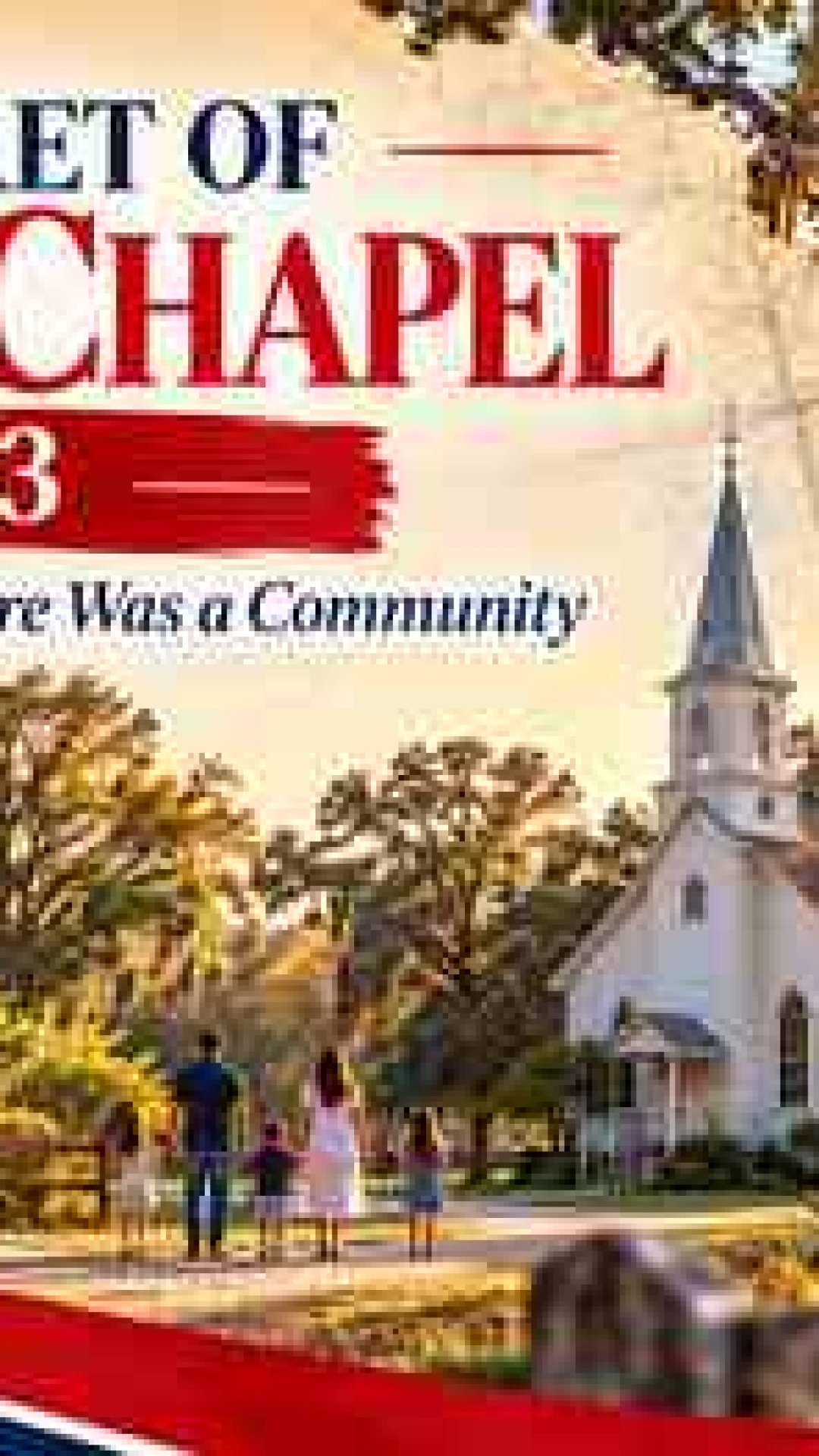


Long before shopping centers, subdivisions, and traffic jams, a little school, a church, and a cemetery helped shape the heart of Wesley Chapel. And their story is more human than you might expect.
WESLEY CHAPEL, FL — October 11, 2026
If you have ever driven along State Road 54 during rush hour, you probably know that Wesley Chapel has mastered at least one modern tradition: bringing neighbors together at traffic lights.
Sometimes for considerably longer than anyone would prefer.
But imagine the same area more than a century ago.
No shopping plazas. No endless lines of cars. No GPS politely announcing that your arrival time has increased by another twelve minutes.
Just rural roads, farming families, children who needed an education, and neighbors building a life together.
You might think that a community needs a town hall, a mayor, and perhaps a very official-looking sign to become a real place.
Wesley Chapel had another idea.
A school. A church. A cemetery.
And, as we discovered, a few determined families who understood that a community is not something you simply name.
It's something you build.
Three Places, One Remarkable Story
In Part 1 of The Secret of Wesley Chapel, we discovered that this community has something of an identity puzzle.
It looks like a city. It feels like a city. It certainly has enough traffic to qualify as one.
Yet officially, Wesley Chapel is not an incorporated city.
In Part 2, an old family home helped us understand how memories can outlive the places where they began.
Now, in Part 3, we are going even further back.
Our journey takes us to land associated with the Godwin family, where historical records connect a school, a church, and a cemetery near what is now State Road 54.
At first glance, these might seem like three unrelated subjects.
One for learning. One for praying. One for remembering.
But together, they tell a story about the everyday business of belonging.
Because before a community has fancy entrances, neighborhood newsletters, and debates about where the next supermarket should go, it needs people willing to show up for one another.
And in early Wesley Chapel, people were already doing exactly that.
A School, a Teacher, and Eight Very Important Dollars
Picture a classroom in rural Florida in the late 1800s.
No tablets, interactive whiteboards, or online homework portals.
And definitely no parents asking why the school app needs another password reset.
The records tell us that one early Wesley Chapel school session ran from November 4, 1878, through March 7, 1879.
Its teacher was John E. Savage, listed in documents as Jno. E. Savage.
Other teachers followed, including Sallie R. Center, B. L. Ray, and B. L. Blackburn.
We don't have detailed accounts of their teaching methods, classroom conversations, or what happened when students forgot their lessons.
But the records tell us something more fundamental.
This rural community was making education a priority.
And one entry from 1887 is particularly revealing.
Jacob Godwin, serving as a school trustee, presented a deed for one acre of land intended for a school.
He also asked the school board for money to purchase hinges and locks for the new schoolhouse.
The approved amount?
Eight dollars.
Yes, eight.
Of course, eight dollars in 1887 had considerably more purchasing power than it does today.
Still, there is something wonderfully human about a historical record that reminds us of a simple problem:
You can have land, a schoolhouse, and a teacher, but somebody still has to make sure the door closes.
It's the sort of practical detail that rarely makes it into grand historical narratives.
And yet, those small decisions are often how real communities take shape.
Someone offers land.
Someone organizes the school.
Someone teaches the children.
Someone figures out the hinges.
History doesn't always arrive with a marching band.
Sometimes it arrives carrying a toolbox.
The Teachers Who Helped Build Wesley Chapel
There is another part of this story worth remembering.
Schools are not made only of buildings.
They are made of people.
Over the following decades, surviving records identify teachers who worked in Wesley Chapel, including Minnie Sims, Ella Mobley, Maggie Smith, Winifred Shearer, Alatha Tucker, Clarence and Vera Martin, Warren Bates, Blanche Geiger, and Cora Cripe.
A particularly interesting record comes from 1922.
J. P. Hodge was appointed principal, with his wife, Frances Hodge, serving as assistant.
By October, a local newspaper reported that both had resigned and replacements were being arranged.
Apparently, finding and keeping school staff was already a challenge long before modern education invented the phrase "staffing shortage."
The circumstances behind their resignations aren't established by the record cited here, so we won't invent them.
But even that little administrative episode reminds us that early Wesley Chapel wasn't a picture-perfect postcard.
It was a real community, with real people and real challenges.
And teachers kept arriving.
One historical photograph of the Wesley Chapel School from the 1926–27 school year offers a glimpse of that world. Historical research identifies Mitchell Emery Lefler and Georgia Wells as the teachers believed to appear in the photograph.
Think about what a photograph like that represents.
A classroom full of people whose everyday lives were as important to them as ours are to us.
Children who grew older.
Teachers who moved on.
Families who changed.
And an education that became part of the community's foundation.
We may not know every student's story.
But we know their school mattered enough to leave a record behind.
The Church That Brought People Together
A short distance away in this historical landscape, another institution was helping build community life.
The Double Branch Baptist congregation traces its founding to June 2, 1878.
According to the history maintained by today's First Baptist Church of Wesley Chapel, it began with 34 adult charter members.
Thirty-four people.
Today, Wesley Chapel can attract a sizable crowd with the announcement of a new restaurant.
Back then, 34 adults were enough to begin a congregation whose history would extend across generations.
But the most revealing moment in this chapter may have come decades later.
In January 1935, a newspaper announcement described plans to build a new church on the site of the old Double Branch church.
And the invitation was simple: anyone who wanted to help was welcome.
No online registration.
No digital calendar invitation.
No complicated sign-up system requiring three confirmation emails.
Just an invitation for people to lend a hand.
The historical announcement doesn't tell us exactly who arrived, what tools they carried, or how many hours each person worked.
But it does show that rebuilding the church was presented as something neighbors could participate in together.
Later that year, the replacement building was dedicated.
The congregation continued through changing times and eventually became known as First Baptist Church of Wesley Chapel.
That continuity matters.
Because a building can be replaced while the human connections associated with it continue.
And sometimes those connections say more about a community than the building itself.
The Quietest Place May Hold the Loudest Memories
Now we come to the third place in our story.
The cemetery.
It doesn't have the energy of a schoolyard.
It doesn't have the gatherings of a church service.
And unlike almost everything else in modern Wesley Chapel, it doesn't seem especially interested in expansion plans.
But it holds something essential.
Memory.
The Double Branch Cemetery preserves a physical connection to families whose lives were woven into the community's early history.
A historical marker installed in 2003 describes the land associated with Mary Jane Godwin and its significance to the church and cemetery.
The marker identifies James Strickland, who died on January 30, 1908, as the person in the oldest marked grave.
Other early graves connect the cemetery to families including the Godwins, Smiths, Tuckers, and Wells.
It's easy to look at an old cemetery and see only names and dates.
But each marker represents a life.
Someone's parent.
Someone's child.
Someone's neighbor.
Someone who may have walked the same rural roads, attended community gatherings, or watched Wesley Chapel change around them.
We cannot reconstruct those individual experiences without evidence.
What we can say is that the cemetery provides a lasting physical connection to the people who lived in this area long before today's neighborhoods took shape.
And that makes it more than a quiet piece of land.
It makes it part of Wesley Chapel's memory.
The Godwin Family and the Bigger Picture
The Godwin family appears repeatedly in this part of Wesley Chapel's documented history.
Mary Jane Godwin is associated with the transfer of land for the church and cemetery in 1890.
Jacob Godwin appears in school records as a trustee involved in establishing a school site.
He was also the first postmaster of a post office named Godwin, established in 1888.
Put those records together and a fascinating picture begins to emerge.
A school.
A church.
A cemetery.
A post office.
Different institutions, different purposes, but all reflecting the practical needs of people who were building a shared life.
It would be a mistake to claim that the Godwins created Wesley Chapel on their own.
The community's history includes many families, teachers, church members, farmers, and neighbors whose contributions deserve attention.
But the Godwin records give us a useful window into that larger process.
They show how land, public responsibilities, and local participation could connect private family histories with institutions serving the wider community.
In other words, the story isn't really about a family name.
It's about what people did for the place they called home.
When a School Becomes a Memory
Not every building survives the community it helped create.
The original Wesley Chapel School is one example.
Its history continued through changing teachers, changing educational arrangements, and the first half of the twentieth century.
By April 1951, school board records indicate that the school had been discontinued and that the board recommended selling the former school property.
The highest recorded bid for the one-acre property and building was $1,005.
There is something bittersweet about seeing decades of educational history appear in a property transaction.
A place where children once studied had become a former school site.
But the records we have do not establish exactly what happened afterward to every part of the building.
So that remains a question for future research.
And perhaps that's fitting.
The school's story doesn't end neatly with a final bell.
It leaves a trail.
Records.
Names.
A historical photograph.
And questions that may still be answered by families who have preserved old documents and memories.
Maybe Wesley Chapel's Secret Was Never Hidden
Let's return to the Wesley Chapel we know today.
The one with busy highways, growing neighborhoods, supermarkets, restaurants, schools, and sports fields.
The one where people complain about traffic but somehow keep moving here anyway.
More than a century separates this modern community from the rural settlement described in those old records.
Yet there is an interesting connection between them.
The people of early Wesley Chapel needed places to learn, gather, support one another, and preserve their memories.
We still do.
Our schools look different.
Our churches may be larger.
Our neighborhoods stretch across land that once supported farms.
And instead of asking the school board for eight dollars to buy hinges, modern school officials face budgets that would probably make an 1887 trustee sit down for a moment.
But the underlying question hasn't changed.
What makes a collection of houses, roads, and businesses become a place people genuinely call home?
The answer may be surprisingly simple.
People.
People who teach.
People who build.
People who help.
People who remember.
And people who choose to care about a place beyond their own front door.
Wesley Chapel didn't need a mayor to begin becoming a community.
It needed neighbors.
And judging by these historical records, it had plenty of people willing to get things started.
One More Secret Is Waiting
There is still something we haven't fully uncovered.
The old Wesley Chapel School disappeared from everyday life, but its story did not.
Historical documents tell us who taught there, when certain school activities occurred, and how the former property was considered for sale in 1951.
But what happened to the school building afterward?
Could an old family photograph reveal more?
Could an overlooked newspaper clipping help us identify the site more precisely?
Could a longtime family have a memory passed down from someone who attended classes there?
These aren't answers we already possess.
They're the kinds of questions that make local history worth investigating.
And they may lead us somewhere unexpected.
So if you're visiting your parents or grandparents this week, perhaps ask whether they have old pictures or stories about Wesley Chapel.
You never know what might be tucked away in a family album.
A photograph doesn't have to look important to contain a piece of history.
Next Sunday, The Secret of Wesley Chapel continues.
And remember: sometimes a town's most interesting secret isn't buried beneath the ground.
It's sitting in a shoebox somewhere, waiting for someone to ask about it.
Have an old photo, family document, or memory connected to Wesley Chapel? Wesley Chapel Today welcomes historical tips that may help tell the community's story.
Sources:
- West Pasco Historical Society — Wesley Chapel community history: https://westpascomuseum.org/pascohistory/historicalinformation/communities/wesley_chapel/
- West Pasco Historical Society — Wesley Chapel School historical records: https://westpascomuseum.org/pascohistory/historicalinformation/education/schools/wesley_chapel_school/
- First Baptist Church of Wesley Chapel — Church history: https://www.fbcwesleychapel.org/about
- Historical Marker Database — Double Branch Baptist Church and Cemetery: https://www.hmdb.org/m.asp?m=101055
- West Pasco Historical Society — Historical education records: https://westpascomuseum.org/pascohistory/historicalinformation/education/school-board-minutes/education3/