

THE SECRET OF WESLEY CHAPEL · SEASON 2 · EPISODE 2
From the arrival of their earliest ancestors in the nineteenth century to the farms that have endured in the area, discover the story of one of the families that helped shape our community's identity.
WESLEY CHAPEL, FL — Wesley Chapel Today
Last week, we opened a new season of The Secret of Wesley Chapel with a broad look at the past. We tried to imagine the daily routine of the first pioneers who came to this part of Florida when nearly everything still had to be built — an era of simple houses, sandy roads, cattle raising, and days when work began before dawn and seldom ended before sunset.
But who, exactly, were those people?
Throughout this season, we will bring those names out of old books and get to know them, one by one: Boyette, Godwin, Ryals, Kersey, Mendenhall, Smith, Gillett, and Stanley. We will discover where they came from, how they earned a living, and, whenever possible, what became of their descendants.
And there is no better place to begin than with the Boyettes — a family whose presence here now spans almost two centuries.
Arriving in Florida — and a mystery in the dates
In traditional local accounts, the Boyette story in Wesley Chapel begins in 1843. Around that time, Edward Boyette Sr. and his four sons reportedly arrived, drawn by land grants in Florida's interior that were attracting families willing to establish farms from scratch. By the 1840s, the Boyette name was already among the area's early landholders, alongside the Gilletts, Godwins, and Kerseys.
Interestingly, when the family itself began looking more deeply into its roots, it found that the story was not quite as precise as it seemed. Michael C. Boyette, a descendant who devoted years to the family's genealogy, found documents pointing to a 640-acre land grant to John Boyette in 1849. He also noticed that old county boundaries and lost historical records made it difficult to determine exactly where the earliest properties had been located.
So although 1843 remains the traditional landmark in local memory, the family's own research shows that questions remain about those early years. In the end, that reveals something common among old families: almost nobody inherits a family history neatly written and bound. Grandchildren and great-grandchildren have to put the pieces together.
Illustrative timeline. The traditional 1843 date and the 1849 record are neither equivalent nor conclusive.
A journey that began long before
The Boyettes' journey did not begin in Florida. According to Michael Boyette's research, earlier generations had lived in Virginia, North Carolina, and Georgia before putting down roots here, following successive waves of settlement across the American South.
In older records, the surname appears sometimes as Boyett and sometimes as Boyette — a normal variation in an age when spelling often depended on the ear of whoever filled out the paperwork. When they finally reached the Wesley Chapel area, they were not simply changing addresses; they were bringing a long journey to an end. With every state left behind, one generation said goodbye to what it knew, while another grew up learning a different landscape and climate. Eventually, Wesley Chapel stopped being another point on the map and became the place where the family truly took root.

Historic road in Eastpoint, Florida; regional reference, not Wesley Chapel. Florida Memory / State Library and Archives of Florida.
Far more than one farm
Agriculture was always at the heart of the Boyettes' livelihood, but country life required flexibility and a range of work. Beyond what they grew for their own tables, the family also earned a living from timber and commercial crops — watermelon harvests and forestry work are among the activities remembered by older generations.
In those days, living off the land meant depending directly on the weather's moods, the quality of the soil, available tools, and the difficulty of moving produce along rough roads. Children did not have a long, carefree childhood in that environment: they grew up working alongside the adults, learning early the skills that would support them later.
As the years passed, some children stayed on their parents' land, while others established their own properties nearby. Marriages joined local surnames together — in the family tree Michael Boyette assembled, for example, the Boyettes are connected to the Coopers, Wellses, and Stanleys. No family's story unfolded on its own; it became woven into the story of the whole neighborhood.

Rural property documentation from Baker County; not a Boyette farm. HABS / National Park Service.
Conversations in the citrus grove
Perhaps the loveliest part of this family's journey is how its memories were passed down. As a boy, Michael Boyette loved hearing the stories his grandmother told. Years later, working alongside his grandfather in a citrus grove near Double Branch Baptist Church, he kept listening to those recollections of earlier generations.
One day, as he thought them over, Michael realized that some of the stories did not quite agree. Instead of brushing the differences aside, he grew curious. He began searching old certificates, comparing dates, and talking with distant relatives who were also investigating the past. Little by little, he uncovered a family history far larger and more complicated than he had imagined.
It is a familiar experience for many people who have lived in Wesley Chapel a long time. Everything begins with an offhand remark from a grandfather or a yellowed photograph at the back of a drawer, and soon the questions come: Who was this person? Where did they live? What happened to their children? In searching for answers, Michael helped save an important piece of our community's memory.
Editorial diagram of family continuity, not a documented family tree.
The landscape changed around them
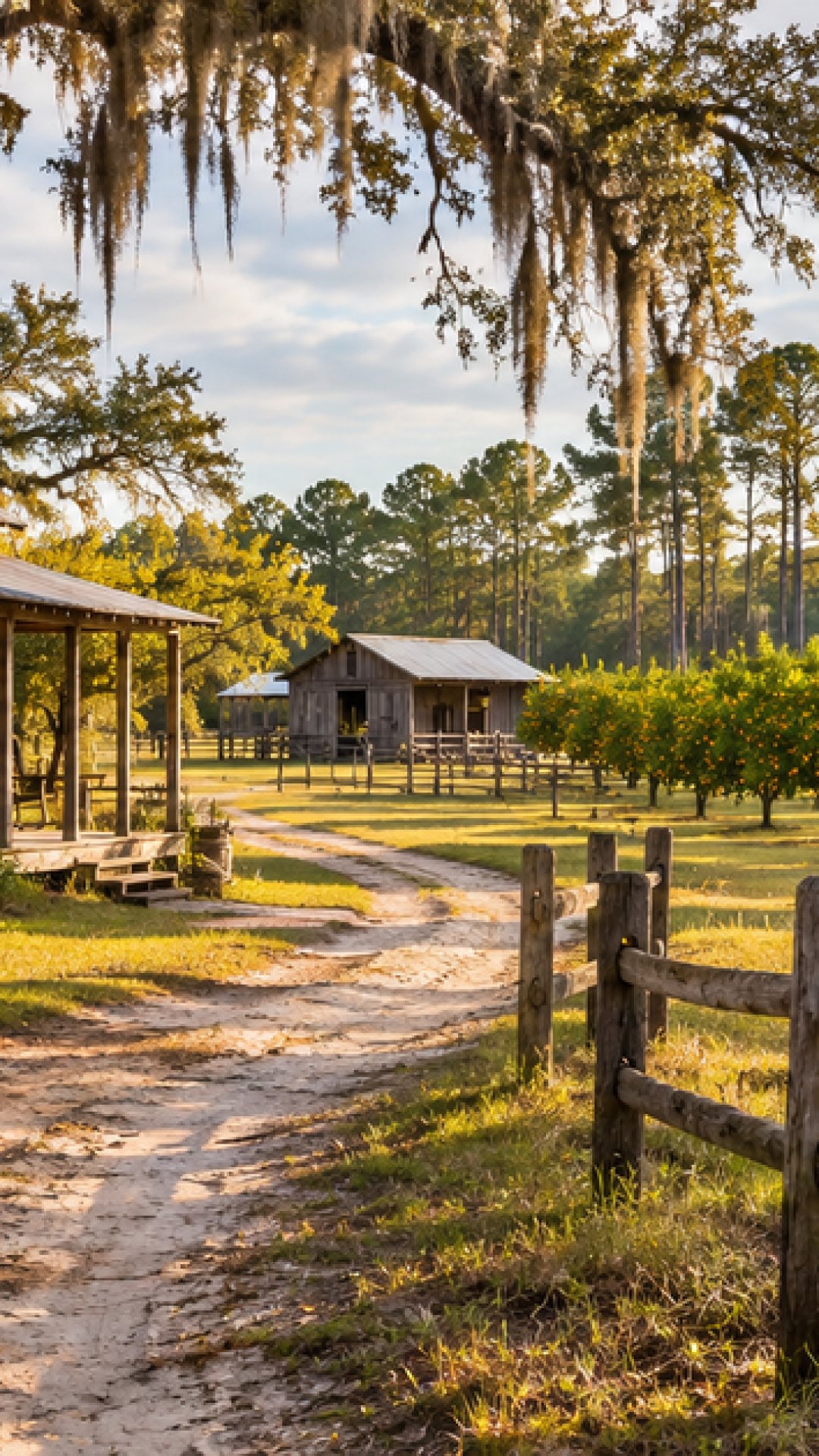
For decades, Wesley Chapel was a quiet place defined by citrus groves, pastures, and dirt roads that looked nothing like today's busy traffic. Calvin Boyette, a fifth-generation descendant, grew up on the family's property along Boyette Road. In a 2024 interview with Tampa Bay 28, he remembered a time when barely a hundred people lived within a four- or five-mile radius — almost impossible to picture when we look at today's neighborhoods and avenues.
The transformation came gradually, driven by major highways and rapid urban growth. Meanwhile, people who depended on farming suffered hard blows from nature. Calvin recalled severe freezes in the late 1970s, followed by harsh winters in 1983 and 1984, that wiped out much of the area's citrus crop. As land became increasingly valuable to real estate developers, many neighbors decided it made more sense to sell their properties than to start planting again from nothing. The rural landscape slowly gave way to a new Wesley Chapel.

Cattle in a Florida pasture, 1929; not the Boyette herd. Florida Memory.
The land that stayed in the family
We could end the Boyette story in the nineteenth century, but that would leave out its most meaningful chapter: they never really left.
The same 2024 report showed that the old family property on Boyette Road remained a gathering place for different generations. Brooks Boyette, Calvin's son, founded Boyette Farms to keep the family's agricultural calling alive, selling fruit, vegetables, and local products directly to area residents. His sister, Laci Stokes, also returned to the family land and opened Boyette Fresh, a food-and-drink business on the farm itself. At the time of the interview, three Boyette generations still lived side by side on the same property.
The work adapted to changing times, the products changed, and today's customers are very different from those of a century ago. Even so, the bond with the land survived. That is what keeps the Boyette story from becoming a mere footnote in the past: the family lived through every stage of Wesley Chapel without losing its footing.
A surname that put down roots
Some old family names fade with time, remembered only in courthouse records. Others remain alive on street signs, on properties that endure, and in stories shared around the table. The Boyette name clearly belongs to that second group.
When Edward Boyette and his sons arrived here in the 1840s, they could not have imagined that those isolated lands would become one of Florida's fastest-growing areas — much less that nearly two hundred years later their descendants would still be harvesting crops at the same address and telling the family story. That continuity is precisely why the Boyettes open our season.
Next episode
The Boyette story continues next Sunday with the land that kept the name alive: Boyette Family Farms. How did a family property become a working farm stand where Wesley Chapel residents still shop today? We will return to Boyette Road to find out.
To be continued…
| Nº | Sources |
|---|---|
| 1 | History of Pasco County — Wesley Chapel · fivay.org |
| 2 | Zephyrhills Historical Association — Tracks of Time (November 2017) · fivay.org |
| 3 | Tampa Bay 28 — Boyette family one of Wesley Chapel’s pioneering families (2024) · tampabay28.com |
| 4 | The Laker/Lutz News — Author unearths details of Wesley Chapel’s past · lakerlutznews.com |
| 5 | Florida Memory / Wikimedia Commons — historical road · commons.wikimedia.org |
| 6 | HABS / Wikimedia Commons — historical farmstead · commons.wikimedia.org |
| 7 | Florida Memory / Wikimedia Commons — cattle, 1929 · commons.wikimedia.org |
Editorial note: This series presents a narrative inspired by the community's history and memories. Facts attributed to identifiable people are based on the cited references; reflective passages express the editorial perspective of Wesley Chapel Today.