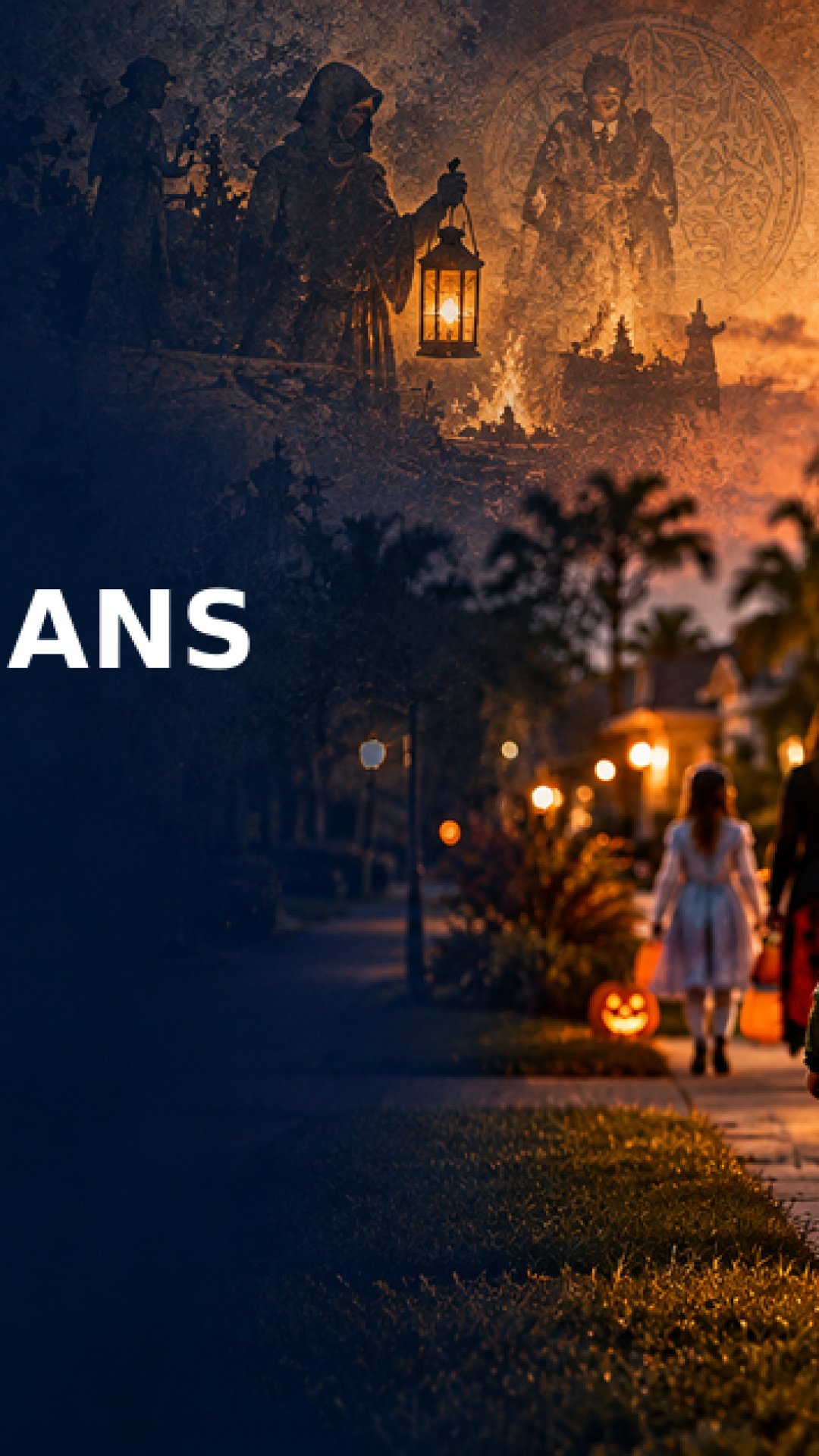


Porch lights, costumes and bowls of candy will turn October 31 into one of the most recognizable nights of the American year. In Wesley Chapel, as in communities across the country, Halloween is now largely a neighborhood and family occasion. Its history, however, is older and more layered than the modern ritual of ringing a doorbell and saying “trick or treat.”
Halloween did not emerge from one custom at one moment. Historians trace important parts of it to the ancient Celtic festival of Samhain, Christian observances surrounding All Saints’ Day and centuries of folk beliefs. Those traditions changed again after they crossed the Atlantic and became part of American popular culture.
The history is a blend of traditions, not a straight line from one ancient festival to today.
From Samhain to All Hallows’ Eve
Samhain marked the end of summer and the beginning of the darker part of the year in the Celtic seasonal calendar. Folklore connected that transition with the boundary between the living and the dead. The Library of Congress describes Halloween as a holiday shaped by the blending of pagan and Christian festivals and by ideas about natural and life cycles.
The English name also carries that mixture. “Hallow” is an older word for a holy person or saint. All Hallows’ Eve was the evening before All Hallows’ Day, now commonly called All Saints’ Day. Over time, “Hallowe’en” lost its apostrophe in everyday American spelling and became “Halloween.”
That history does not mean a modern child in a superhero costume is reenacting an ancient ceremony. Customs were repeatedly adapted, secularized and commercialized. The connection lies in the accumulation of seasonal imagery—darkness, spirits, masks, food and gatherings—not in an unchanged ritual surviving intact.
How the celebration became American
Halloween celebrations gained visibility in the United States in the late 1800s. Early American versions often centered on home parties, games, fortune-telling and playful scares. Pranks could also become vandalism, which encouraged communities to organize activities that redirected the night toward supervised entertainment.
Trick-or-treating became widespread during the 1930s and expanded after World War II as growing suburban neighborhoods placed many families—and many front doors—close together. The exchange created a simple neighborhood bargain: children performed a small ritual at the door and householders offered a treat.
The familiar door-to-door version grew with organized communities and postwar neighborhoods.
Why candy took over
Treats were not always factory-wrapped. Families once handed out homemade cookies, popcorn balls, fruit, coins or small toys. The Smithsonian’s National Museum of American History notes that packaged candy became increasingly popular in the 1950s. It was convenient for households, easy for companies to market and simple for children to carry.
By the 1970s, concern about accepting homemade food from strangers helped make sealed, individually wrapped candy the expected choice. That change reinforced the commercial side of Halloween, but it also standardized the custom across neighborhoods.
Costumes, suspense and neighbor-to-neighbor exchange connect the holiday’s many versions.
What October 31 means in Wesley Chapel
Today’s Halloween mixes old symbols with a distinctly American community ritual. A lit porch commonly signals participation; an unlit one generally means children should move on. Costumes turn fear into play, while the brief exchange at the door gives neighbors a reason to meet.
Wesley Chapel’s subdivisions, community gatherings and family events fit that modern pattern. The celebration is not the same for every household: some residents embrace its history and spectacle, others take part only in the social tradition, and some do not observe it. Participation is optional, and courtesy remains the simplest local rule.
For families going out Saturday, the meaning behind the night may be complex, but the practice is straightforward: respect homes that are not participating, accompany young children, make costumes visible to drivers and inspect treats before eating them. Halloween survived by changing. In its current American form, its most enduring feature may be the way one evening turns an ordinary neighborhood into a shared stage.
Sources
https://www.loc.gov/item/today-in-history/october-31/
https://guides.loc.gov/chronicling-america-halloween
https://americanhistory.si.edu/explore/stories/halloween-putting-apostrophe-back
https://americanhistory.si.edu/explore/stories/homemade-halloween-treats-colorfully-packaged-candies
https://americanhistory.si.edu/explore/stories/new-woman-meets-old-witch