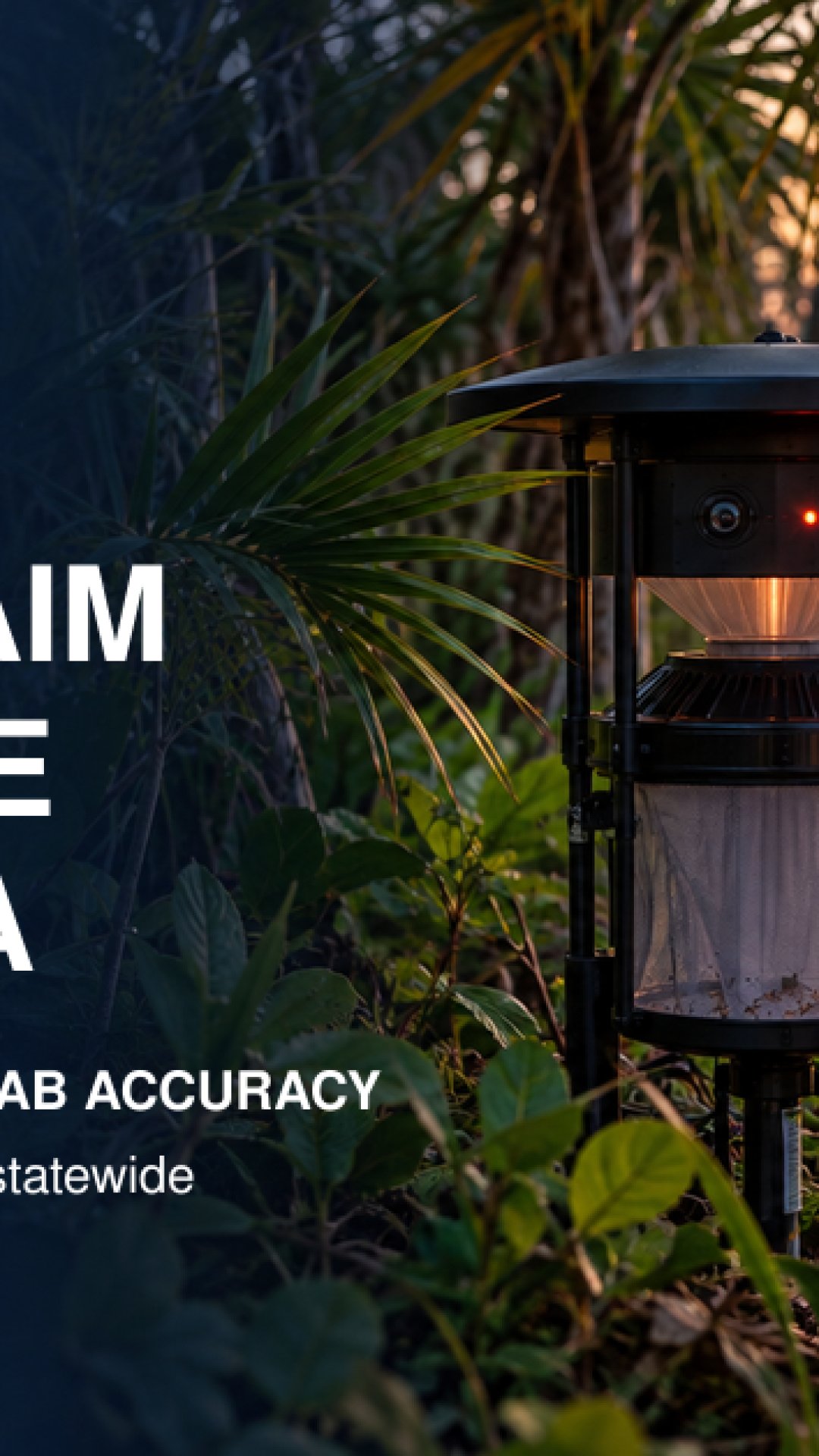


Technology created in the Tampa area identified mosquito species with more than 98% accuracy in laboratory testing and could speed up control decisions during outbreaks.
As Florida faces a dengue outbreak that has surpassed 700 reported cases in 2026, University of South Florida researchers are developing a tool that replaces part of the time-consuming microscope work with cameras, cloud computing and artificial intelligence.
The smart trap created by Digitomy, a USF-affiliated startup, photographs captured mosquitoes and uses AI to identify their species, sex and even signs that an insect has fed on blood. In laboratory testing, the system achieved more than 98% accuracy in species identification, according to the university.
For Wesley Chapel, the interest extends beyond the technology itself. The community is in Pasco County, one of the counties in the region that declared a local emergency during the outbreak, and it borders Hillsborough County, the center of Florida’s reported cases. Faster surveillance could help control districts understand where disease-carrying mosquitoes are present and where an intervention could have the greatest effect.
How the smart trap works
The system combines physical capture, imaging, automated classification and mapping.
The problem AI is designed to solve
In traditional surveillance, specialists collect traps and manually examine the insects. USF Professor Sriram Chellappan said the microscope-based process can take two to three days. That delay matters when teams must quickly decide where to look for breeding sites or apply treatment.
Inside the Digitomy trap, mosquitoes are held on a sticky pad. Two cameras record images, and the system compares the insects’ characteristics with a large photo database. Results can be sent to a cloud platform and displayed on a geographic dashboard.
The goal is not simply to count mosquitoes. The tool is designed to distinguish species, identify males and females and recognize whether an insect has taken a blood meal. That information can help estimate the presence and concentration of disease vectors, particularly Aedes aegypti, the primary mosquito associated with dengue transmission in Florida.
The numbers behind the story
The statewide total includes reported cases with different routes of acquisition; it does not represent only local transmission.
Promising technology still moving through validation
The National Science Foundation-supported research behind Digitomy has been underway at USF since 2018. The team has tested the technology in the laboratory and is working with the Anastasia Mosquito Control District, which serves the St. Augustine area.
The next relevant step for the Tampa region is preparation for field validation with Hillsborough County. The researchers are also seeking to license the system to trap manufacturers and move it closer to market. The technology has advanced beyond an academic concept, but it is not the same as statewide deployment or confirmed adoption in Pasco County.
The team integrated trap data into a private layer of the Global Mosquito Observations Dashboard, which also draws on more than half a million citizen-science reports. Separately, USF researchers are studying smartphone-submitted images and recognition algorithms to expand species monitoring.
Why this matters to Wesley Chapel
The potential advantage is a faster and more precise map. Instead of treating a broad area without knowing exactly where a disease-carrying species is concentrated, teams could use recent data to prioritize neighborhoods, investigate small pockets of standing water and measure whether an intervention reduced the mosquito’s presence.
For Pasco, that possibility is particularly relevant because the county already faces the need to control Aedes aegypti and evaluate new strategies. A tool capable of identifying species on the same day could eventually complement conventional traps, inspections and treatments. That use in Pasco remains a possibility, not an announced program.
Technology also does not replace residents’ role. The guidance remains straightforward: drain standing water, wear clothing that reduces exposed skin and use registered insect repellent. Artificial intelligence may speed up the map; it cannot tip over the forgotten bucket in the backyard by itself.
Important information
- Reported cases in Florida: 721, according to CDC data cited October 23.
- Center of the outbreak: Hillsborough County remains the area with the largest concentration of cases.
- Technology: Digitomy trap developed by USF-affiliated researchers.
- Accuracy: more than 98% for species identification in laboratory testing.
- What it identifies: species, sex and signs of a blood meal.
- Current status: testing and preparation for field validation; no confirmed statewide adoption.
- Connection to Pasco: potential for faster future surveillance, with no announced local deployment.
Sources
- University of South Florida — New AI-powered mosquito trap could help curb dengue outbreaks, October 23, 2026: https://www.usf.edu/news/2026/new-ai-powered-mosquito-trap-could-help-curb-dengue-outbreaks.aspx
- University of South Florida — AI and Citizen Science for Mosquito Surveillance: https://www.usf.edu/ai-cybersecurity-computing/centers/ai-x/research/mosquito-surveillance.aspx
- Centers for Disease Control and Prevention — Current Year Data (2026), Dengue: https://www.cdc.gov/dengue/data-research/facts-stats/current-data.html
- The Washington Post — Dengue cases in Florida continued to climb after emergency declared, October 23, 2026: https://www.washingtonpost.com/nation/2026/10/23/dengue-cases-florida-continued-climb-after-emergency-declared/