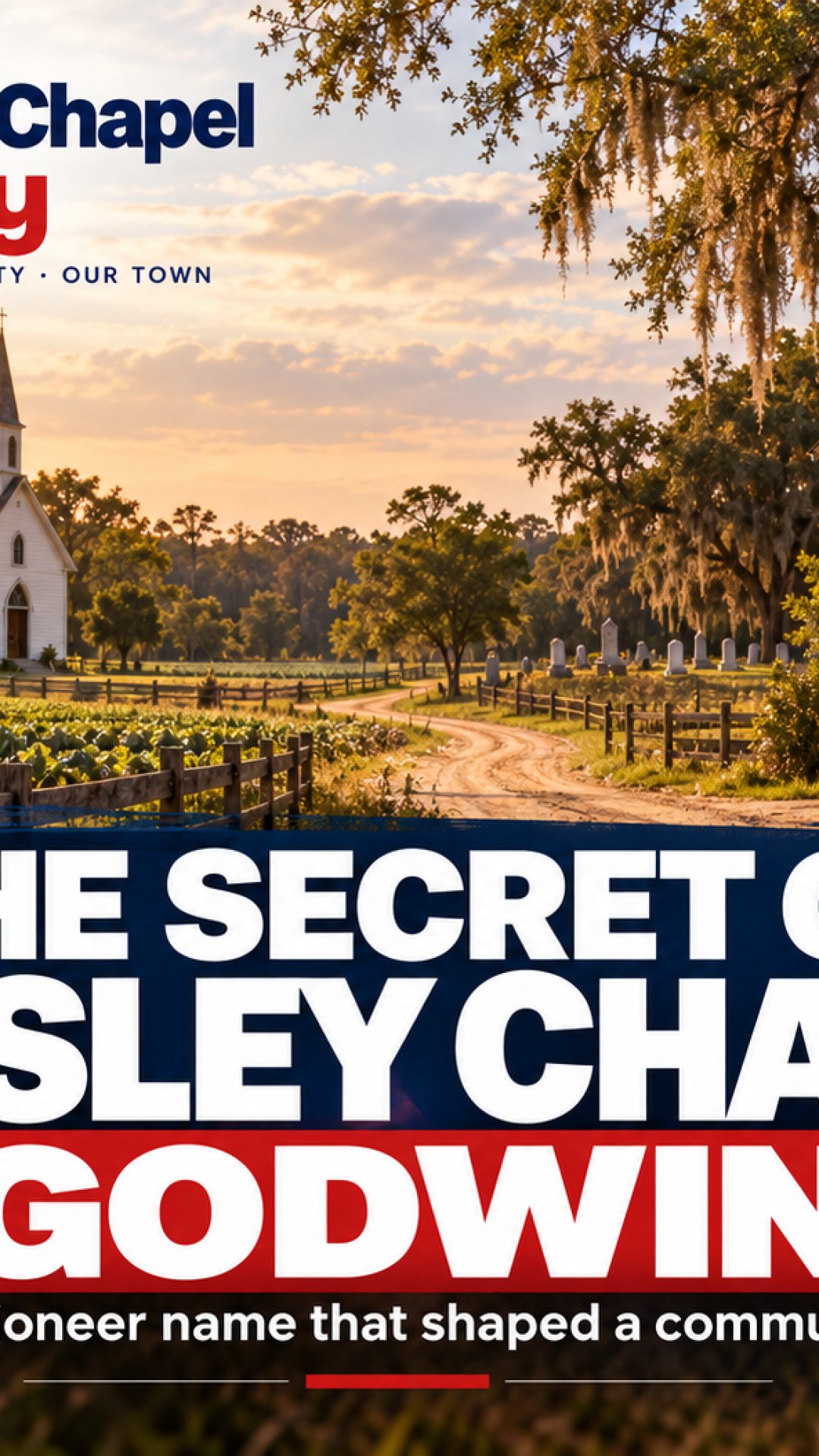

A part of the Wesley Chapel area was once known simply as Godwin. It was the name of a pioneer family whose history is woven into the beginnings of this rural community. One of its best-documented members was Jacob Godwin, whose name appears in the records of the school, the church, and the post office.
A farming community built by neighbors
In the nineteenth century, the Double Branch area was home to farms, fields, and dirt roads used to carry crops toward nearby markets. Farming families including the Godwins, Boyettes, Gilletts, and Kerseys helped shape the community. Good farmland meant opportunity, but difficult roads made getting produce to market a challenge.
A community needed more than crops. Children needed a school; families needed a place to worship; letters needed a way to reach their destinations; and families needed a place to remember loved ones. The school, church, post office, and cemetery became essential parts of local life.
Mr. Godwin and the school
Historical school records identify Jacob Godwin as a school trustee in 1887. He took part in the work of organizing the local school, including presenting a deed for an acre of land intended for its use.
In a farming settlement, a school offered children the chance to learn while the next generation grew up around the fields and homesteads. Building and maintaining it took neighbors willing to shoulder responsibilities. Jacob was among them.
The man who handled the mail
On March 15, 1888, a post office named Godwin was established, with Jacob Godwin as its first postmaster.
Letters carried news from relatives, business information, and important documents across distances that were not always easy to travel. The postal service linked scattered families to other towns and to the wider country.
Jacob returned to the postmaster position in 1899. The Godwin post office continued operating until 1915. For years, the family's surname marked a vital point of contact for this rural community.
The church and its neighbors
The Double Branch Baptist Church was organized in 1878 and became an important gathering place for local families. An entry dated April 1, 1893, identifies Jacob Godwin as the congregation's church clerk.
The records thus place him in three institutions that helped the settlement thrive: the school, the post office, and the church. Each served a different need, but all brought neighbors closer together.
A family that put down roots
Historical accounts also associate Jane Godwin with land transfers for the Double Branch church and cemetery. Those sites became places of lasting meaning for generations of residents.
The Godwin surname appears repeatedly in the history of land and community institutions, reflecting the family's place among the area's pioneers.
How a family name became a place name
A post office carried the name Godwin from 1888 onward, and historic records and maps also used the name for part of the area.
In 1922, the Dade City Banner described the community by four names: Double Branch, Gatorville, Godwin, and Wesley Chapel.
Those names did not represent four formal changes of a town's official name. They were different ways people knew the same rural region. Wesley Chapel eventually became the familiar name, while Godwin remained a part of its history.
The legacy of Mr. Godwin
Jacob Godwin belonged to a generation of pioneers who helped a community take shape. His documented work with the school, the post office, and the church shows how deeply involved he was in everyday local life.
The strength of that settlement lay in people working together: cultivating land, teaching children, keeping families in touch, gathering in faith, and caring for neighbors.
His name became more than a family name. It became part of Wesley Chapel's story.
Tomorrow: Gatorville!
Godwin was only one of the four names. Next comes perhaps the most curious: Gatorville. A fittingly Floridian name — although perhaps not everyone's first choice if they preferred to keep their distance from alligators.
Where did it come from? What did it mean to the early residents?
Tomorrow, in The Secret of Wesley Chapel, we'll explore Gatorville. More names, and more stories, are still to come.
Do you know the Godwin family?
Wesley Chapel Today welcomes historical photographs, letters, deeds, and family records connected with the pioneer Godwin family. Help preserve the stories of our community.
Sources
- History of Pasco County — Wesley Chapel: https://www.fivay.org/wesley_chapel.html
- History of the Wesley Chapel School: https://www.fivay.org/wesley_chapel_school.html
- West Pasco Historical Society — Wesley Chapel: https://westpascomuseum.org/pascohistory/historicalinformation/communities/wesley_chapel/
- Wesley Chapel Today — The Secret of Wesley Chapel, Part 4: https://wesleychapeltoday.com/news/the-secret-of-wesley-chapel-part-4-four-names-and-a-nearly-forgotten-post-office