

WESLEY CHAPEL, Fla. - A kitchen remodel can begin with a color choice and end with a network of suppliers, fabricators and installers. For Wesley Chapel homeowners considering marble, granite or quartzite, the decision is both a design purchase and a practical investment in how a home works.
The area's housing profile provides a useful backdrop. Census figures put Wesley Chapel's population at 64,866 in 2020, compared with 44,092 in 2010. For 2020-2024, QuickFacts reports 77.1% owner occupancy, a $403,700 median owner-occupied home value and $107,504 median household income.
Those figures suggest a substantial potential customer base for home-improvement services. They do not measure countertop spending or prove that local natural-stone sales are rising. This article is an overview of the market's housing context and purchasing considerations, not a local sales survey.
More than a slab
Natural stone enters many renovation plans through kitchen counters, bathroom vanities, backsplashes and outdoor cooking areas. Each application brings different priorities: appearance, maintenance, exposure to weather, installation requirements and the way a family uses the space.
Marble, granite and quartzite should not be treated as interchangeable names. They are distinct natural materials, and a buyer should ask about the specific slab rather than assume that every product in a category performs identically.
Engineered quartz is another category altogether: a manufactured surface, not the same material as natural quartzite. Porcelain, solid surface, laminate and wood are also alternatives. Comparing them should include care requirements, warranty terms and the total installed cost, rather than price per square foot alone.
The attraction of a natural slab is partly visual. Its pattern can become a defining element of a room. But the sample on a showroom counter may not show the complete slab's variations. Viewing the actual material and discussing the layout before fabrication can help avoid surprises.
A project connects several trades
A countertop installation can involve a stone supplier, fabricator, installer, cabinet company, plumber, designer and contractor. The homeowner may see one finished surface, but the work behind it crosses several specialties.
That creates potential business opportunities around renovation. It also creates coordination risks. A new sink, changed cabinet layout or different appliance can affect the countertop plan. Measurements, support requirements and installation timing should be agreed upon before cutting begins.
For Wesley Chapel residents, the useful question is not simply which stone looks best. It is who takes responsibility for each step, what is included in the quote and how changes are handled.
Ask whether the estimate includes measurements, fabrication, edge treatment, sink openings, delivery, installation, removal of the existing countertop and reconnection of plumbing. Confirm which services require a separate contractor. A low initial figure is not necessarily the lowest final bill.
Safety belongs in the conversation
OSHA and NIOSH identify silica dust as a worker hazard when natural or engineered stone is cut and finished. Their guidance calls for exposure controls, including wet methods and effective ventilation. Choosing a contractor should include asking how dust will be controlled, particularly if cutting is planned inside the home.
This is a fabrication issue, not a reason to assume an installed countertop is unsafe in ordinary use. Homeowners should not attempt unprotected cutting, grinding or drilling themselves.
Buying for the home you actually use
A busy family kitchen, guest bathroom and exposed outdoor kitchen are different environments. Ask the supplier for written guidance on cleaning, sealing where required, stains, acidic spills, heat and outdoor suitability for the exact product being considered.
Request a written layout showing seams and the intended use of the slab's pattern. Clarify what happens if the slab has a defect, delivery is delayed or an installation issue appears after completion.
Local demand cannot be reduced to population growth alone. Interest rates, household budgets, remodeling decisions and competition from other surfaces all influence purchasing. Without verified local sales data, claiming a boom would go beyond the evidence.
What the housing figures do establish is a community with a substantial homeowner base. For natural-stone businesses, that is a potential market. For residents, it is a reason to approach a renovation with clear specifications, comparable quotes and realistic expectations.
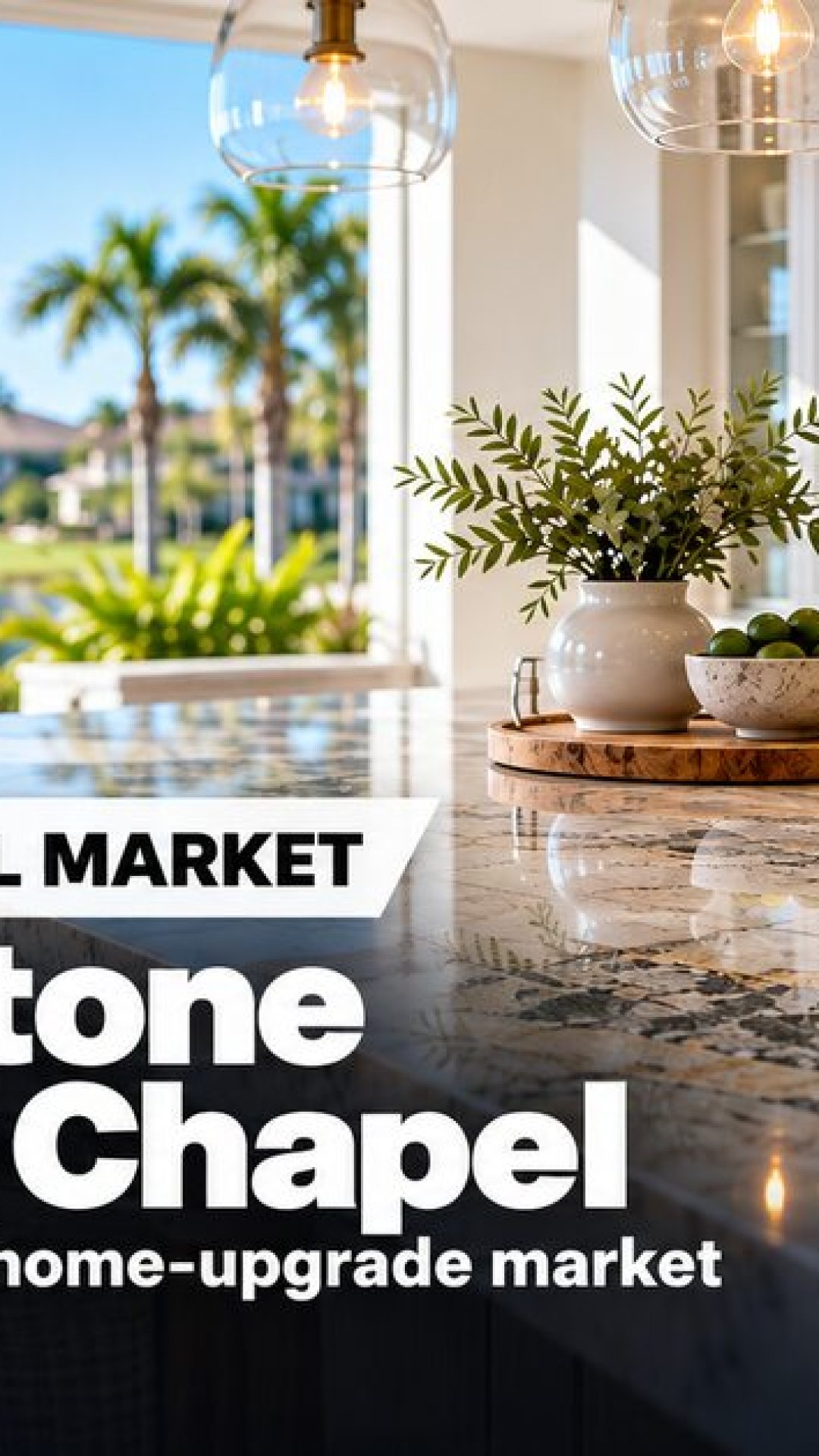
Cover: AI-generated editorial illustration; not a photograph of a specific Wesley Chapel property.
Sources:
- U.S. Census Bureau, Wesley Chapel CDP QuickFacts: https://www.census.gov/quickfacts/fact/table/wesleychapelcdpflorida/PST045225
- OSHA and NIOSH, Worker Exposure to Silica during Countertop Manufacturing, Finishing, and Installation: https://www.osha.gov/sites/default/files/publications/OSHA3768.pdf
- OSHA, Crystalline Silica: https://www.osha.gov/silica-crystalline